Thursday, February 23, 2017

A Gilded Age throwback: Palm Beach, home of Mar-a-Lago - CBS News

A Gilded Age throwback: Palm Beach, home of Mar-a-Lago - CBS News


A Gilded Age throwback: Palm Beach, home of Mar-a-Lago

Sunday Morning

Palm Beach was America's TREASURE ISLAND long before Mr. Trump arrived, as Mo Rocca shows us in our Cover Story: 

The first thing you should know about Palm Beach is that it's an island (unto itself). 

"It was separate from the rest of Florida," said writer Laurence Leamer. "It was separate the rest of America. It was the most exclusive town in America."

For more than 20 years Leamer has lived in Palm Beach, which he calls "America's first gated community."

Rocca asked, "Achievement, lineage, or money? What confers status here?"

"They would like to think it's culture and lineage, but it's money," Leamer replied. "It's all about money. Your friendship's here defined by money. People look at you, 'I know what that tie is worth. I know what that suit is worth. I know where you belong. And you're a great guy, but you don't belong among the billionaires, okay?'"

infopalm-beach-mar-a-lago-620.jpg
CBS News

Today, Worth Avenue is one of the most glamorous stretches of shopping in America. Just 110 years ago it was "jungle trail" and the site of an alligator farm.

It was Henry Morrison Flagler who transformed Palm Beach. Flagler, the co-founder of Standard Oil, came to this tropical wilderness in the 1890s and envisioned a paradise for the very wealthy.

"At a time when many of his peers would've been thinking about retirement, he's embarking on an enormous project," said Tracy Kamerer, chief curator of the Whitehall Flagler Museum. "The Hotel Royal Poinciana was his first hotel property on the island, the world's largest wooden structure, and it also had the distinction of being the world's largest hotel, ultimately accommodating 1,500 guests."

Vanderbilts, Rockefellers and Carnegies arrived, most (like Flagler) in their own private rail cars, along the railroad which Flagler himself built, opening Florida to tourism. 

He also built the famed Breakers Hotel, and then his own spectacular estate, Whitehall.  Call it "beaux art in the jungle." 

The mansion, says docent Lisa Jensen, was Flagler's wedding gift to his much-younger third wife.

"She liked to throw parties," Jensen said. "She liked to play the piano and sing. And so she really brought some sunshine into his later years."

"What were their ages when they got married?" Rocca asked.

"71 and 34."

"That's sort of a Palm Beach tradition, no?"

"Yes, I'd have to agree with you on that. It is, yeah."

According to Kamerer, Flagler's home and the two hotels he built were really the beginning of Palm Beach society -- a society that soon needed fabulous homes to match its fabulous wealth.

Enter architect Addison Mizner.

He, says preservation consultant Jane Day, created the "Mediterranean revival look" -- a mash-up of European styles that became the architecture of choice for the Palm Beach elite. "You forget you're not in Italy or Europe or Spain," she told Rocca.

"It was a very romantic style. He'll try and mix and match things from different places around the Mediterranean. He wanted it to look as if it had been in the family for generations, so that it didn't look like it was all done in 1919, for example."

infopalm-beach-fountain-620.jpg
CBS News

Villa Mizner, as the name would suggest, was the home of Mizner himself. Today it is home to the family of Dee and Nick Adams, a direct descendant of President John Adams, and their pet pig, Mona Lisa.

"His idea was to bring the light in, bring the air in, make the windows bigger, but retain that Gothic feel," Nick said.

Panels in the dining room are said to have originally lined Spanish Queen Isabella's 15th-century palace. Tiles from 16th-century Portugual are joined by tiles made to look like 16th-century Portuguese tiles.

Rocca asked, "Can you guess what Addison Mizner might think of Palm Beach today?"

"I think he would say it was very much like he had envisioned it, at least this area here," replied Dee Adams. "'Cause he himself was an eccentric."

For example, Mizner owned a monkey named Johnny Brown that ran around the very premises.

Another Mizner landmark, La Guerida, was home to the Kennedy family.  President John F. Kennedy worked on his inaugural address here, in what he called his "winter White House." 

Which brings us to Mar-a-Lago, now the winter White House of President Donald Trump.  

Built by Post Cereal fortune heiress Marjorie Merriweather Post and her husband, E.F. Hutton, Mar-a-Lago is dazzling even by Palm Beach standards.

Olympia Devine, who has written the Trump-authorized history of the estate, explained an inscription found throughout the estate: "Plus ultra," which means "beyond the ultimate."

"And that is symbolic of how Mrs. Post led her life and what her expectation was for this property," Devine said.

Mrs. Post bequeathed Mar-a-Lago (which means "sea to lake") to the federal government to be used as a presidential retreat after her death in 1973. But then-President Richard Nixon preferred Key Biscayne. And so the costly white elephant was returned to the Post family, who couldn't find a buyer … until a certain real estate developer came along.

CBS News' Maria Shriver visited with Donald Trump in 1986:

Shriver:  "You're not going to do anything? No personal Trump touches here?"
Trump: "No. Believe it or not, no."

If Palm Beach was America's first "gated community," says Larry Leamer, then Donald Trump was perhaps its most brazen gatecrasher.

"They despised him from day one," Leamer said. "Did everything to try to stop his arrival in this town. And he didn't care. He was gonna do what he's gonna do."

Mr. Trump bought Mar-a-Lago and turned it into a social club. But unlike Palm Beach's other infamously exclusionary clubs, Mar-a-Lago accepted gentiles and Jews, as well as African-Americans and openly-gay members (as long as they could pay). 

Rocca asked, "What do you think motivated Donald Trump to do this?"

"Money," Leamer replied. "But he did it. I mean, a lot of people wouldn't do it. Would they want to start a largely Jewish Club in Palm Beach? Would they do that? Would you do that if you cared about social acceptance? Would you do that if you cared about the WASP elite on the island? You would never do that!"

Along the way, Mr. Trump has picked plenty of fights, over everything from the height of the flagpole on his club's lawn, to the flight path over Mar-a-Lago that he wanted changed. 

Getting elected president solved that pesky problem.

Rocca asked, "Are you surprised that this is now the winter White House?"

"Well, it's amazing. I wouldn't have dreamed it," said Bernd Lembcke, the longtime managing director of Mar-a-Lago. "But of course I don't think anyone would have thought that would happen."

"That he would become president?"

"Yes, and it shows, in America, anything can happen. And it's a great thing, you know?  It's really fantastic."

Lembcke says Mr. Trump is continuing Mrs. Post's great tradition of hosting, with one significant difference: "Mr. Trump, when he took over and made it a club, he did the same thing: He invited his friends, but for an initiation fee."

"So it's still a home for friends, but friends that pay an initiation fee?"

"Right, yes. And this way, it helps with the cost, you know?"

"I gotta try that with my own friends!"

For at least the last few years, members of Mar-a-Lago have paid $14,000 a year in dues, and a $100,000 initiation fee. But according to Lembcke, "We get a lot of requests for membership. We moved the membership fee up to $200,000, nonrefundable."

The doubling of the initiation fee, effective January 1, has been confirmed, prompting some to question whether Mr. Trump is profiting from his election. The club claims the fee had been $200,000 back before the last recession.

So, does attendance tend to spike when Mr. Trump is present?

"Phenomenally," said Olympia Devine. "You know, instead of five people for lunch, we may have 150 people. It's incredible."

It seems that the relationship between Donald Trump and Palm Beach has changed.

"Before the election, nobody in this island would say a good word about him," Laurence Leamer said. "Now, suddenly, everybody in the island has voted for him!"

      
For more info:

© 2017 CBS Interactive Inc. All Rights Reserved.


^ed 

Trump's Mar-a-Lago visits are hurting business, companies say - CBS News

Trump's Mar-a-Lago visits are hurting business, companies say - CBS News


Trump's Mar-a-Lago visits are hurting business, companies say

MoneyWatch Small Business

Learn More

LANTANA, Fla. -- President Donald Trump's frequent visits to Mar-a-Lago have companies at a nearby airport in a financial nosedive.

The Secret Service closed Lantana Airport on Friday for the third straight weekend because of the president's return to his Palm Beach resort, meaning its maintenance companies, a banner-flying business and another two dozen businesses are also shuttered, costing them thousands of dollars at the year's busiest time. 

The banner-flying company says it has lost more than $40,000 in contracts already.

The airport, which handles only small, propeller-driven planes and helicopters, is about 6 miles southwest of Mar-a-Lago, well within the 10-mile circle around the resort that's closed to most private planes when he's in town. Trump flies into Palm Beach International Airport, which is 2.5 miles from Mar-a-Lago, and remains open as it handles commercial flights.

infopalm-beach-mar-a-lago-620.jpg
CBS News

The Lantana owners are pushing for compromises they say will keep their businesses open while ensuring the president's security. They include letting pilots fly in a closely monitored corridor headed away from the resort until they are outside a 10-mile ban around Mar-a-Lago and a 30-mile zone where flying lessons are restricted. Pilots, planes and cargo would undergo preflight screening by Transportation Security Administration agents.

"None of us are suggesting that we shouldn't do everything to keep the president safe but we believe there are things that can be done to keep us in operation," said Jonathan Miller, the contractor who operates the Palm Beach County-owned airport.

28 businesses, 200 jobs

The airport and its 28 businesses have an economic impact of about $27 million annually and employ about 200 people full-time, many of them making about $30,000 a year. They don't get paid when the airport is closed.

Miller is already losing a helicopter company, which is moving so as not to deal with the closures. That will cost him $440,000 in annual rent and fuel sales.

White House spokeswoman Stephanie Grisham directed questions to the Secret Service. The agency also declined comment. 

Flight restrictions have long been standard around buildings where a president is staying to protect him from an airborne attack.

infotrumps-palm-beach-rtsycbp.jpg
REUTERS/Carlos Barria

Marian Smith, owner of Palm Beach Flight Training, said her 19-year-old business is losing 24 flights daily when closed and three students cancelled. She lost $28,000 combined the last two weekends and will lose $18,000 on this President's Day weekend. She estimates her 19 instructors are each losing up to $750 a weekend.

"What's frustrating is that we get little notice when this is going to happen," she said.

This week, rumors began Monday. The closure notice arrived Wednesday.

U.S. Rep. Lois Frankel, a Democrat who represents the area, met with the business owners this week. She said she will meet with the Secret Service next week to see if a compromise can be reached.

Lantana Airport opened in 1941 as a Civil Air Patrol station, with planes flying along the coast during World War II to spot German submarines attempting to sink cargo ships. Today, the 300-acre, three-runway facility handles an average of 350 arrivals and departures daily, peaking on winter weekends as tourists enjoy South Florida's temperate weather. Summer, with its stifling, visitor-repelling heat and the constant threat of plane-grounding thunderstorms, is not nearly as lucrative.

"We've gotten nothing"

David Johnson, owner of Palm Beach Aircraft Services, said his 27-year-old repair and maintenance business generates $2 million in sales annually, but has taken a hit over the last month and he fears it will cascade if flight schools like Smith's close. He has written a letter he hopes gets delivered to Trump this weekend asking him, one businessman to another, to help resolve the conflict.

"Even if the TSA had to screen every pilot going out of here, we would be open to that," Johnson said. "But so far, we've gotten nothing."

Jorge Gonzalez, owner of SkyWords Advertising, a banner towing service, said his company lost four contracts totaling $42,500 because of Trump's visits. He wants exceptions made for three pilots to fly within the restricted zone when the president visits because it is where thousands of residents live and tourists stay.

"We have spent 10 years building this business," said Gonzalez's wife, Hadley Doyle-Gonzalez. "We just can't pick up and move."

© 2017 The Associated Press. All Rights Reserved. This material may not be published, broadcast, rewritten, or redistributed.


^ed 

Cost of Trump's travel to Mar-a-Lago approximately $10M - CBS News

Cost of Trump's travel to Mar-a-Lago approximately $10M - CBS News


Trump's Mar-a-Lago trips cost taxpayers about $10M so far

CBS This Morning

Budget watchdogs are criticizing the cost of President Trump's visits to Mar-a-Lago, his private club in Palm Beach, Florida. Mr. Trump has been at his so-called "Winter White House" the past three weekends. That's 11 of his first 33 days in office. The travel has an estimated price tag of $10 million.

Between Secret Service and police surrounding the estate, and the U.S. Coast Guard in the surrounding waters, Mar-a-Lago is a fortress when the president is here. The White House won't disclose the exact cost of Mr. Trump's visits, but the $10 million estimate is based on figures from a similar trip by President Obama in 2013.

infopalm-beach-mar-a-lago-promo.jpg
CBS News

Air Force One accounts for a big chunk of the presidential travel budget, costing more than $180,000 per hour to operate, reports CBS News correspondent Manuel Bojorquez. That means the roughly four-hour roundtrip flight to his seaside estate costs more than $700,000.

"If he's going down there every weekend, the costs are going to add up pretty quickly," said Tom Fitton, president of watchdog group Judicial Watch. Fitton is pressing the administration to release Mr. Trump's travel costs.

"He doesn't need to go to Florida every weekend. He can work at the White House or up at Camp David," Fitton said.

Mr. Trump often attacked his predecessor over his travel. He once tweeted: "President @barackobama's vacation is costing taxpayers millions of dollars---Unbelievable!"

President @BarackObama's vacation is costing taxpayers millions of dollars----Unbelievable!

— Donald J. Trump (@realDonaldTrump) January 5, 2012

Four years ago, a weekend Mr. Obama spent in South Florida cost taxpayers $3.6 million. The Pentagon spent about $2.8 million for Air Force One plus support aircraft and military personnel. The Secret Service and the Coast Guard added nearly $800,000.

During his eight years in office, Mr. Obama racked up about $97 million in travel costs. Mr. Trump is on pace to eclipse that by the end of his first year. 


Another cost of keeping Mr. Trump safe? Disruptions to businesses near Mar-a-Lago. The airspace around Lantana Airport in Palm Beach County is restricted whenever the president is in town. On an average day, there are around 300 takeoffs and landings. But when the president is there, nothing's moving — except the bottom line for businesses that operate out of this airport. They say they lose about $30,000 each weekend they're closed.

Others welcome the presidential visits to Palm Beach. Ed Kassatly owns a boutique in the ritzy Worth Avenue shopping district.

"President Trump will bring many more high-end visitors to the community, which is definitely going to help everyone on a high economic scale," Kassatly said.

Regardless of who is in office, presidential trips are never cheap. Clearly, the president must be kept safe. But he also needs to travel with a large contingent of aides so he can continue running the government, especially during emergencies.

© 2017 CBS Interactive Inc. All Rights Reserved.


^ed 

Rare: President Trump wants to be accessible for the American people, but he’s racking up quite a bill by frequently leaving the White House


President Trump wants to be accessible for the American people, but he's racking up quite a bill by frequently leaving the White House
Rare

Donald Trump has spend three of his five weekends as president at his Mar-A-Lago club in Palm Beach, and it's costing millions of tax dollars every weekend — perhaps as much as $10 million just since he took office, according to an analysis by CBS News. It's something Trump attacked his predecessor for again and again but seems to be quite comfortable with now. With a record deficit and $15 trillion in debt, @BarackObama is spending $4 million of our money on his Hawaii vacation. Just plain Read the full story


Shared from Apple News


^ed 

Logo

Sent from my BlackBerry® by Boost Mobile

Saturday, February 11, 2017

CyberCrimes Updated Timeline Circa 2011

Worst. Year. Ever. 


P


image1.PNG


Update June 29: 2011 Cyber Attacks (and Cyber Costs) Timeline (Updated)


I found this interesting graph from an original Thomson Reuters post, showing the timeline of the major 2011 CyberAttacks.


The graph shows all the main Cyber Events of this tremendous 2011 up to June, the 16th. Actually to be perfect it should include also the infamous Epsilon Data Breach, happened on March, the 30th. Probably it had a major impact on the U.S. rather than in Europe, but it is clear that the aftermaths of this breach will last for years in terms of spear-phishing attacks tarteting the affected users.

Moreover, to be “ultra perfect”, it shpould also include the other attacks discovered against U.S. Defense Contractors (L-3 on April, the 6th, and Northrop Grumman on May, the 26th) should be considered as well.

Even if some attacks are missing, the graph is useful (and meaningful) to show the easiness with which our data are at risk.

Of course after June, the 16th, another cyber-attack leading to a breach was perpetrated against Sega (to be added to the list of Game Publisher), affecting 1.3 million users.

Following the Sega Breach, in these last two days, after the #Antisec Manifesto and the consequent teaming between LulzSec and Anonymous, several government sites have been hit by massive DDoS attacks, including SOCA in UK, some sites affiliated to PM Silvio Berlusconi in Italy, and some Government Sites in Brazil.

Related articles

Sega Hit With Cyber Attack (shoppingblog.com)


Another Breach In The Wall (paulsparrows.wordpress.com)


Via @twitter 

http://www.hackmageddon.com/2011/06/22/2011-cyberattacks-timeline/


Sunday, January 15, 2017

Anonymous Written January 2008

Anonymous

Written January 2008

When YouTube pulled down a leaked Tom Cruise video hyping the Church of Scientology, it unleashed the wrath of the hacker collective Anonymous. The group attacked Scientology websites and rallied protests of the church via social media. Over the next several years, Anonymous became a potent political force. During 2011's Arab Spring, the group launched Operation Tunisia to fight against government surveillance. The next year, Anons claimed to have attacked 650 websites in Israel after the country’s latest actions in the Gaza Strip.

Power Grids and Fighter Jets are where we are now. 


Fast forward to April 2009.  

Current and former U.S. officials revealed to The Wall Street Journal that Chinese and Russian spies hacked our critical infrastructure, including power  grids. One official said that the intruders had not yet sought to destroy these systems, but had left behind software programs that would enable them to do so at the flick of a switch. “If we go to war with them,” he warned, “they will try to turn them on." Department of Homeland Security head Janet Napolitano said that “the vulnerability is something [we] have known about for years.” Reports also implicated China for hacking into the plans for the Pentagon's $300 billion Joint Strike Fighter project. The Chinese Embassy responded in a statement that China "opposes and forbids all forms of cybercrimes” and called the reports “a product of the Cold War mentality…fabricated to fan up China threat sensations."

North Korea

July 2009

After sanctions were imposed on North Korea following nuclear tests in late May, the U.S. and South Korea faced days of sustained cyberattacks. In the U.S., computers at agencies including the Defense Department, the Treasury Department, the Secret Service, the State Department, the Federal Trade Commission and the Federal Aviation Administration were subjected to denial-of-service attacks, along with tens of thousands of computers in South Korea, according to that country’s National Intelligence Service. Though North Korea was suspected of having orchestrated the attacks, the source remains unknown.

Operation Aurora

January 2010

Google was attacked by hackers in China. Dubbed Operation Aurora, after the type of application the hackers used, the massive case of cyberespionage was later attributed to the Chinese government, with U.S. companies including Adobe, Symantec, Northrop Grumman, Morgan Stanley and Yahoo falling victim. U.S. government officials later said that the hackers breached a secret database with what the Washington Post called “years’ worth of information about U.S. surveillance targets,” specifically Chinese spies being monitored in the United States.

Stuxnet

Summer 2010

Cyberwar entered a dangerous new era with Stuxnet, a computer worm said to have been created by the U.S. and Israel that attacked a uranium-enrichment plant in Iran. By compromising the industrial systems-operation software, Stuxnet was capable of spying on and controlling the computers, as well as destroying centrifuges. Stuxnet, which could be installed on infected thumb drives, spread out of control to at least five other countries, including the U.S. Defense Secretary Leon Panetta warned of a possible “cyber Pearl Harbor.”

Operation Shady RAT

August 2011

McAfee, the security-research firm, uncovered a massive five-year wave of hacker attacks against governments, nonprofits and corporations around the world. Called Shady RAT, for the remote-access tool used by the infiltrators, the breaches hit over 70 organizations including government agencies in the U.S., Taiwan, Canada, and India, as well as the International Olympic Committee and several defense contractors. McAfee attributed the attacks to a single state actor, though didn’t name the country, which some sources believe to be China. "This is the biggest transfer of wealth in terms of intellectual property in history,” a McAfee exec said at the time. “The scale at which this is occurring is really, really frightening.”

U.S. Weapons Plans Hacked

May 2013

In a report prepared for the Pentagon, the Defense Science Board found that hackers from China had accessed plans for more than two dozen of the U.S.’s most advance weapons systems. The targets included the Patriot missile system, Aegis ballistic-missile-defense system, Black Hawk choppers and the $1.4 trillion F-35 Joint Strike Fighter, the costliest fighter jet ever made. “When I look at the theft of intellectual property to the tune of $1 trillion,” said Texas Rep. Michael McCaul, “that’s a serious economic issue for the United States.” A Chinese Foreign Ministry spokesman responded by saying that “China pays high attention to the cybersecurity issue and is firmly opposed to all forms of hacker attacks.”

Iran Hacks U.S. Energy Companies

May 2013

Hackers, with the support of the Iranian government, were exposed for targeting oil and gas companies in the U.S. "This is representative of stepped-up cyberactivity by the Iranian regime. The more they do this, the more our concerns grow," one U.S. official said. "What they have done so far has certainly been noticed, and they should be cautious."

U.S. Goes on the Cyberoffensive

June 2013

An unpublished presidential directive from Obama leaked, showing that the U.S. is going on the cyber offense. “Offensive Cyber Effects Operations,” the report stated, “can offer unique and unconventional capabilities to advance U.S. national objectives around the world with little or no warning to the adversary or target and with potential effects ranging from subtle to severely damaging.” Among other things, the report authorized cyberwar attacks when “U.S. national interests and equities” were at stake, but also left room for “anticipatory action” just in case. Adding fuel to the fire, National Security Agency leaker Edward Snowden claimed that the U.S. has already hacked thousands of targets, including computers in China.


  • I

Cyberwar, like any war, never rests. Neither does the simulated one taking place at HackMiami, where co-founder Rod Soto, a 38-year-old computer-security specialist from the area, is running a cyberwar game. Though the consequences of their hacking are fake, the technology they’re breaking is real. They actually are hacking Fedora, an operating system used by computers in China, infiltrating Zeus, a malicious “botnet” army of computers, and commandeering North Korean industrial controls for power-plant systems. It’s just that everything’s simulated and run on a closed network, so as not to inadvertently start World War III. The purpose of this event, besides the recruiting going on, is to teach the hackers how to find vulnerabilities in other nation’s machines. “It gives you the blueprint and the knowledge if you ever want to attack them,” Soto says.

So far, the truth about the extent of the U.S.’s offensive attacks against other countries has been shadowy at best. There’s Stuxnet, which has yet to be officially attributed to the U.S. (or Israel), and NSA leaker Edward Snowden’s recent claim the U.S. has launched widespread cyberattacks against China. Beyond that, the closest we’ve come was Hillary Clinton’s admission last year of a State Department attack on an Al Qaeda propaganda site in Yemen.

Related: Julian Assange Opens Up About Wikileaks Battle, House Arrest and the Future of Journalism

The tensions around this topic are partly because the laws governing cyberwar are still being determined. As Rear Adm. Margaret Klein, chief of staff of Cyber Command, the Ft. Meade-based defense center for U.S. military networks, put it last year, “Attorneys and scholars face a variety of complex legal issues arising around the use of this new technology.” But experts are pushing for more offensive measures regardless. The Commission on the Theft of American Intellectual Property concluded that “new options need to be considered.” It seems our government is already heeding the call.

A June leak of a presidential directive from Obama, which had been issued in October, reveals that the U.S. is, at the very least, getting its cyberwarriors in line. In addition to calling for a list of international targets, the directive argued that “Offensive Cyber Effects Operations... can offer unique and unconventional capabilities to advance U.S. national objectives around the world with little or no warning to the adversary or target and with potential effects ranging from subtle to severely damaging.”

But while the government remains quiet about the existence or extent of their offensive measures, hackers and contractors I spoke with are, albeit cautiously, more forthcoming. HackMiami organizers James Ball and Alex Heid, security specialists for a major financial company they prefer not to name so as not to anger their bosses, say they have based this weekend’s cyberwar simulation on real-life hacks they conducted on their own of terrorist networks and organized-crime groups. Ball infiltrated an Al Qaeda forum online and posted the archives on his site, TerroristMedia.com. Heid became notorious for hacking the stealthy Zeus botnet in Russia.

But the government hires private contractors to do such attacks on its behalf as well. The cyberwar underworld is rife with contractors who fashion themselves to be “the Blackwater of the Internet,” as Heid puts it, “information mercenaries…private sector guys who are going on the offensive, but you don’t hear about it.” At least not usually.

Companies like Accuvant are capable of creating custom software that can enter outside systems and gather intelligence or even shut down a server, for which they get can paid up to $1 million. For example, Humperdink says, they would be able to unleash an attack to take a country like China completely offline. “We could stop their cyberwarfare program,” he says. “Five years ago, I remember the North Koreans were doing missile testing, right? If [the U.S. government] came to a company like us and said, ‘Here’s $15 million,’ we could turn a North Korean missile into a brick. If you came to us with $20 million and said, ‘We wanna disable every computer there in Iran, and they’d have to replace them’ – not a problem.” For added flair, each program Accuvant sells gets its own cyberpunk handle – like Purple Mantis – and is delivered on a jet-black thumb drive inside a custom case with the name laser-etched on a plaque.

“So how many offensive plays are going on now?” I ask.

“A lot,” Bonvillain says.

“More than people would realize?”

“Yes,” he replies.

Then Bonvillain falls silent. He puffs his e-cigarette, considering a more diplomatic response. “The U.S. government,” he says, “is great at hiding everything they do.”

To see what the front line of cyberwar really looks like, I visit the National Cybersecurity and Communications Integration Center in Arlington, Virginia, the Department of Homeland Security’s mission control. It’s one of our most important hubs in digital warfare, alongside the FBI and NSA. A wall of video screens show online the attacks on the IRS and NASA – both agencies were compromised by a Distributed Denial of Service Attack, a technique that floods a site with access requests, slowing or downing it completely.

The four-year-old NCCIC – employees pronounce it “enkick” – is the country’s nerve center for online threats. Twenty-four hours a day, teams drawn from a pool of 500 DHS cyberpersonnel sit at the ready in this sprawling, windowless command cave. Flickering diagrams on the front wall track the dangers in real time: traffic anomalies at federal agencies, cyberalert levels for each state’s website, a map of our country’s telecommunications system (“There’s no cyber without fiber!” a steely engineer tells me).

Fortunately, at the moment, the threat against the IRS and NASA proves to be relatively harmless. However, the number of cyberincidents is on the rise. Fiscal year 2012 saw 190,000; this year’s number is already over 214,000.

Overhauling the feds’ image to lure young tech talent has become a major priority. In a way, it’s akin to the shift in Silicon Valley – away from the business suits of IBM to the Adidas sandals of today. The National Science Foundation now offers a CyberCorps Scholarship for Service program that places winning students in government agencies. The DHS is among the sponsors of the invite-only “Cyber Camps,” which hold hacking contests for prospective employees. Aside from the “sense of duty” and high-level security clearance that NCCIC director Larry Zelvin tells me lures his team away from fat paydays elsewhere, the power of being inside the government system is the greatest perk. “You just don’t get that in a corporation,” he says.

Last year, the DHS assembled a cyberskills task force, which drew from hacker hubs including Facebook and DefCon, to recommend changes in their recruiting. To get the estimated 600 more hackers the DHS needs, the report concluded, the agency should “focus more attention and resources on…‘branding’ of cybersecurity positions,” including “cool jobs.”

Napolitano says that “the money and the culture” are the chief obstacles the Department of Homeland Security runs into when recruiting hackers to join. “We don’t require our folks to wear a coat and tie,” she says, “and I’m not interested in the precise hours they work as much as I’m interested in getting the work done” – but she stops short of saying hackers can work from home in Teenage Mutant Ninja Turtle pajamas.

But maybe if you’re young and brilliant and looking for online action, there’s something undeniable about working for the biggest, baddest government on the planet. Sitting here under the dormant red warning lights, there’s a sense of being at the center of the matrix – and this is plenty tantalizing for some, including th3_e5c@p15t, winner of the cyberwar contest back at HackMiami. With his skills, he can write his own ticket, which he hopes to cash in with the feds. He says he wants to be as close to the front line as he can get: “I see it as a righteous cause.”

Wednesday, January 4, 2017

The Gab Security Chronicles

Cross posted via: 

The Gab Fail Chronicles: LOL DDOS, EULA, and NAZIS

Club Pepe

The dishonesty of Andrew Torba knows no bounds in the latest postings. The reality of the mater, as I understand it, is most of the down time was related to fixing the major security issues I’ve raised over the past few days. I do not know how much of it was fixed, but I’m sure there still is major problems to be found. Mr. Torba was well schooled the past few days, the usage of CloudFlare isn’t a magical shield of protection against everything.

gabnazi

It is common knowledge trying to do any kind of DDoS attack on a ClouldFlare IP will be futile with little to no needed intervention to block such an attack. His screams of DDoS is fairly laughable as the vast majority know, I do not engage in such ineffective behaviors, and I have always been against it. He will continue to tell lies to rile his angry Neo Nazi Muppets for exposing how bad Gab really is as an alternative to Twitter. It would be really ironic, if he rallied them for the real reason, exposing Gab as a massive fraudulent security black hole. I’m just not intimidated by his Neo Nazi Muppets and there isn’t anything anyone can do to stop me from publishing write ups about Gab. My words, on a computer screen, are far more deadly to Gab’s platform than any silly illegal attack nonsense.

scavengerhunt

The greatest issue I see here is why was any of this never fixed to begin with, or even considered to be an issue? If it took me 10 minutes to see major issues all over the place, does Gab really take the security of it’s users seriously? It’s just no, they don’t take security seriously, if the most basic skiddiot Hack Forums (There has been some claims Torba is regular of Hack Forums for irony) style methods work unchecked. This further solidifies Gab as being another pump and dump scam by Torba when a lot of the basics are not covered at all. Gab doesn’t even have a logout button, but they have an account delete link, that’s curious indeed!

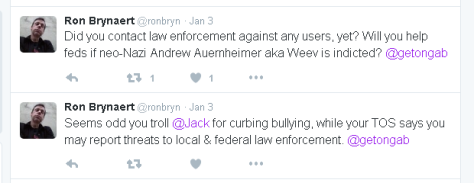
ron-gabtweets

gabsnitch

I don’t wish to keep this post longer than it has to be but it’s worth mentioning parts of the updated EULA were a result of us. It’s humbling that Torba spent the day at his lawyers thinking of us, as he pushed out a new EULA from his nether regions, that still didn’t impress Apple enough. Even the greatest eJournalist to ever live, Ron Brynaert, noticed this updated EULA with the “snitch” clause. I’m not going to spoil the rest of it but any users of Gab really do need to read the updated EULA as well as the Privacy Policy.


^ed