Cyberattack Against WikiLeaks Was Weak
- By Kevin Poulsen

- November 29, 2010 |
- 4:35 pm |
- Categories: Bradley Manning, Wikileaks
In the first test of WikiLeaks’ resiliency since a staff rebellion earlier this year, the organization recovered within hours from a distributed denial-of-service attack during its rollout of leaked State Department cables Sunday. But experts who monitored the disruptive traffic say the attack was relatively modest in size.
WikiLeaks’ main web address and its “cablegate” site were unreachable as the organization’s media partners published their first analyses from a massive trove of a quarter-million U.S. diplomatic cables Sunday afternoon. Hours earlier, WikiLeaks wrote on Twitter: “We are currently under a mass distributed denial-of-service attack.”
But Arbor Networks, which analyzes malicious network traffic crossing the internet’s backbones, reports that the DDoS generated between 2 and 4 Gbps of disruptive traffic, slightly above the average for all DDoS attacks, but well below the peak 60 to 100 Gbps consumed by truly massive attacks against other websites over the last year.
“The traffic that we’re looking at going to the network where WikiLeaks was hosted at the time the attack started is 12 to 15 gigs per second, so 2 to 4 gigs on top of that is not much,” says Jose Nazario, a senior security researcher at Arbor.
The DDoS tested WikiLeaks’ mettle in the wake of a staff rebellion earlier this year that cost the organization a key technical volunteer responsible for its complex bulletproof backend. The volunteer had set up a censorship-resistant system that decoupled WikiLeaks’ document archives from its public internet IP addresses, allowing the site to jump back to life within an hour of losing its hosting.
When that volunteer resigned in September, along with spokesman Daniel Domscheit-Berg and other staffers, WikiLeaks’ founder Julian Assange was given two weeks to “prepare an alternative setup,” the volunteer said in an interview last month. After that, “we pulled off all the technology developed for WikiLeaks and handed the remaining people the machines. We only took with us that which was developed by us.”
The volunteer’s account was confirmed by other former WikiLeaks staffers. “No machines that had been donated to WikiLeaks were removed,” says former staffer Herbert Snorrason, an Icelandic university student. Instead, “the software systems and web systems” were taken out of service.
WikiLeaks’ original website with its archive of leaked documents from around the world has remained offline ever since, while WikiLeaks has focused on the high-profile U.S. leaks linked, with varying degrees of certainty, to Bradley Manning, the 23-year-old former intelligence analyst charged with accessing and disclosing diplomatic cables and other classified files. WikiLeaks launched the Iraq war logs and the State Department cable leaks from dedicated web pages with itinerant hosting.
Despite the issues, WikiLeaks was able to recover from Sunday’s DDoS attack relatively swiftly.
The traffic, directed at WikiLeaks’ Swedish hosting provider Bahnhof, began at approximately 10:05 a.m. EST and originated from “a handful of sources,” says Arbor’s Nazario. Though modest in size, the attack was effective because it opened TCP connections to WikiLeaks’ servers and kept them open, like jamming a switchboard.
WikiLeaks responded by redirecting its web addresses to cloud servers in France and Ireland. The organization announced a functional “cablegate” site shortly after 4 p.m. EST, six hours after the attack began. The site launched with 219 diplomatic cables, and WikiLeaks says it plans to release the entire cache “in stages” over the coming months.
A self-described “hacktivist” called Jester has taken credit for the DDoS. Jester has a history of launching similar attacks against websites said to be linked to radical Islam. He wrote on Twitter that he targeted WikiLeaks “for threatening the lives of our troops and ‘other assets.’”
See Also:
- Cyberwar Against Wikileaks? Good Luck With That
- Unpublished Iraq War Logs Trigger Internal WikiLeaks Revolt
- Newspapers Reveal Diplomatic Cables Provided By WikiLeaks
- Suspected Wikileaks Source Described Crisis of Conscience Leading to Leaks
- U.S. Intelligence Analyst Arrested in Wikileaks Video Probe
Tags: Bradley Manning, WikileaksAlso on Wired.com
Related Topics:
Tuesday, November 30, 2010
Cyberattack Against #WikiLeaks Was Weak | Threat Level | Wired.com


$80B budget to oppress Targeted Individuals (video) - National Human Rights | Examiner.com
$80B thug budget to oppress Targeted Individuals (video)
 Spies in every US neighborhood, 1 million spies targeting mainly innocent individualsPhoto: News4i.com
Sunday, a targeted man compared the societal system of spying, or "ratting," to the old game called "Gossip." Understanding the root of the insidious game, formalized into an $80 billion industry for thugs to inflict torture in a reign of terror on innocent targets, is provided on the Targeted Individual website, developed into the short video below, an in George W. Bush's statements shortly after 911.
Bush's torture not limited to overseas prisons
Some think the Targeted Individual phenomenon sweeping the United States, impacting as many as 350,000 Americans, that spreads out globally, is resultant of organized crime. Others believe it is squarely rooted in government. As president, George Bush stated, it is both.
Hours after 911, Bush announced to the world that his administration would be hiring "thugs" to help "root out" his brand of "terror" because thugs "know how these terrorists think."
The video below summarizes how government is the driving force Targeting Individuals, paying neighbors, even children to be spies, professional stalkers to keep innocent people under surveillance for further secret attacks. These US-based human rights violation attacks now officially include assassinations on US soil and elsewhere in the Bush/Obama 'locate and assassinate' New Phoenix Program that unofficially includes torture.
At the end of October 2010, for the first time, the government officially announced its total spy budget. CNN reported that the US spent $80 billion on "spy activities" in 2010. Among other clandestine operations, spreading Disinformation is a major spy tactic.
Many Targeted Individuals move in attempt for normalcy in their lives. There is, however, no refuge. US intelligence operatives and contracted crime gangs are transnational.
Many Targeted Individuals are forced to move due to professionally executed lies, Disinformation is used by paid infiltrators sworn to secrecy to worm their way into the targets' inner circles and cause havoc for the purpose of neutralizing the target.
There being no refuge for the innocent target should be no more of a surprise than thugs hired to punish the new "terrorist" like peace-workers, whistle-blowers, journalists, 911 truth advocates and other human rights workers - or just ordinary pacified citizens. The prime example of such ordinary citizens are the women whose former partners with the "right connections" get their names on the hit-list.
Bush, now boasting about his authorizing torture, declared via satellite TV the evil plan for Targeted Individuals, precisely what they suffer daily with no police protection according to consistent reports. Bush declared:
"We will direct every resource at our disposal… every tool of intelligence, every instrument of law enforcement, every financial influence, and every necessary weapon of war to the disruption and eventual defeat of terrorism… Either you are with us, or you are with the terrorists… Americans should expect a battle unlike any other they have ever seen, not one battle, but a lengthy campaign, some visible, others secret. We will drive terrorists from place to place until there is no refuge or rest." (1) (Emphasis added)
It was thus clarified: Either you are a war criminal with Bush and his team - or you will be targeted in a lengthy campaign that includes some invisible secrets, (like Directed Energy Weapons, and cyber attacks (2)) with no refuge or rest (due to the 24-7 harassment and torture used to neutralize. Law enforcement has been directed to be complicit in unleashing terror on America's "greatest people,"
Targeted Individual, Julio L. Velazquez recently explained that the human prey are stalked for years after exposing or attempting to halt corruption and that it is often based on rumors, usually fabricated to begin with and then "completely distorted." He knows. He is targeted.
As Targeted Individuals often explain to the writer, they had attempted to halt a human rights violation before they were targeted and still free. Velazquez reported a crime, in his case, a drug crime. He has since been on the receiving end of government sponsored terror that mainstream media calls "spying."
"You know how the story goes," Velazquez stated. "If one starts a rumor and passes it on to another person, and then that person passes it on, etc..then, the original rumor has been totally changed, to make one a monster.
"Ultimately, someone who doesn't know you and who has heard the lie about you and has a propensity to be violent, could possibly harm you, just like they tried to do to Darlene Miles." (Facebook; also see Shattered glass and dreams: Shot at target wants Quaids heard; Dupre, D., Examiner, Nov. 5, 2010) www.examiner.com/human-rights-in-national/shot-targeted-individual-wants-quai...
Speaking from personal injuries and suffering the murders of his family members perpetrated by the "spy" system, Velazquez said, "Criminals take advantage of opportunities and then they try to pass as heroes."
In fact, criminals, or as Bush called them, "thugs," are the new heroes. The whistle-blower is the new terrorist.
There are so many "terrorists," good-hearted Americans and other nationals, an 80 billion dollar budget is required to root them out, while Americans go hungry and homeless.
There is little difference between this system and the Nazis' local community citizen spies called Brown Shirts.
In a society built on lies and informants, nobody is safe.
Surveillance does not stop with watching. The Targeted Individual can, and often is, covertly assaulted in ways to quietly ruin their lives, in secret prison hellholes and in communities.
Do you know who you are trusting?
1. O’Connor. T. The Criminology Of Terrorism: History, Law, Definitions, Typologies, Syllabus for JUS 429. Austin Peay State University. MegaLinks in Criminal Justice
2. Washington Post, Pentagon's Cyber Command seeks authority to expand its battlefield, Nov 6, 2010)
YOU ARE EITHER WITH US OR YOU ARE A TERRORIST
$80B Budget to oppress Targeted Individuals (video) - National Human Rights | Examiner.com
$80B thug budget to oppress Targeted Individuals (video)
Spies in every US neighborhood, 1 million spies targeting mainly innocent individualsPhoto: News4i.comSunday, a targeted man compared the societal system of spying, or "ratting," to the old game called "Gossip." Understanding the root of the insidious game, formalized into an $80 billion industry for thugs to inflict torture in a reign of terror on innocent targets, is provided on the Targeted Individual website, developed into the short video below, an in George W. Bush's statements shortly after 911.
Bush's torture not limited to overseas prisons
Some think the Targeted Individual phenomenon sweeping the United States, impacting as many as 350,000 Americans, that spreads out globally, is resultant of organized crime. Others believe it is squarely rooted in government. As president, George Bush stated, it is both.
Hours after 911, Bush announced to the world that his administration would be hiring "thugs" to help "root out" his brand of "terror" because thugs "know how these terrorists think."
The video below summarizes how government is the driving force Targeting Individuals, paying neighbors, even children to be spies, professional stalkers to keep innocent people under surveillance for further secret attacks. These US-based human rights violation attacks now officially include assassinations on US soil and elsewhere in the Bush/Obama 'locate and assassinate' New Phoenix Program that unofficially includes torture.
At the end of October 2010, for the first time, the government officially announced its total spy budget. CNN reported that the US spent $80 billion on "spy activities" in 2010. Among other clandestine operations, spreading Disinformation is a major spy tactic.
Many Targeted Individuals move in attempt for normalcy in their lives. There is, however, no refuge. US intelligence operatives and contracted crime gangs are transnational.
Many Targeted Individuals are forced to move due to professionally executed lies, Disinformation is used by paid infiltrators sworn to secrecy to worm their way into the targets' inner circles and cause havoc for the purpose of neutralizing the target.
There being no refuge for the innocent target should be no more of a surprise than thugs hired to punish the new "terrorist" like peace-workers, whistle-blowers, journalists, 911 truth advocates and other human rights workers - or just ordinary pacified citizens. The prime example of such ordinary citizens are the women whose former partners with the "right connections" get their names on the hit-list.
Bush, now boasting about his authorizing torture, declared via satellite TV the evil plan for Targeted Individuals, precisely what they suffer daily with no police protection according to consistent reports. Bush declared:
"We will direct every resource at our disposal… every tool of intelligence, every instrument of law enforcement, every financial influence, and every necessary weapon of war to the disruption and eventual defeat of terrorism… Either you are with us, or you are with the terrorists… Americans should expect a battle unlike any other they have ever seen, not one battle, but a lengthy campaign, some visible, others secret. We will drive terrorists from place to place until there is no refuge or rest." (1) (Emphasis added)
It was thus clarified: Either you are a war criminal with Bush and his team - or you will be targeted in a lengthy campaign that includes some invisible secrets, (like Directed Energy Weapons, and cyber attacks (2)) with no refuge or rest (due to the 24-7 harassment and torture used to neutralize. Law enforcement has been directed to be complicit in unleashing terror on America's "greatest people,"
Targeted Individual, Julio L. Velazquez recently explained that the human prey are stalked for years after exposing or attempting to halt corruption and that it is often based on rumors, usually fabricated to begin with and then "completely distorted." He knows. He is targeted.
As Targeted Individuals often explain to the writer, they had attempted to halt a human rights violation before they were targeted and still free. Velazquez reported a crime, in his case, a drug crime. He has since been on the receiving end of government sponsored terror that mainstream media calls "spying."
"You know how the story goes," Velazquez stated. "If one starts a rumor and passes it on to another person, and then that person passes it on, etc..then, the original rumor has been totally changed, to make one a monster.
"Ultimately, someone who doesn't know you and who has heard the lie about you and has a propensity to be violent, could possibly harm you, just like they tried to do to Darlene Miles." (Facebook; also see Shattered glass and dreams: Shot at target wants Quaids heard; Dupre, D., Examiner, Nov. 5, 2010) www.examiner.com/human-rights-in-national/shot-targeted-individual-wants-quai...
Speaking from personal injuries and suffering the murders of his family members perpetrated by the "spy" system, Velazquez said, "Criminals take advantage of opportunities and then they try to pass as heroes."
In fact, criminals, or as Bush called them, "thugs," are the new heroes. The whistle-blower is the new terrorist.
There are so many "terrorists," good-hearted Americans and other nationals, an 80 billion dollar budget is required to root them out, while Americans go hungry and homeless.
There is little difference between this system and the Nazis' local community citizen spies called Brown Shirts.
In a society built on lies and informants, nobody is safe.
Surveillance does not stop with watching. The Targeted Individual can, and often is, covertly assaulted in ways to quietly ruin their lives, in secret prison hellholes and in communities.
Do you know who you are trusting?
1. O’Connor. T. The Criminology Of Terrorism: History, Law, Definitions, Typologies, Syllabus for JUS 429. Austin Peay State University. MegaLinks in Criminal Justice
2. Washington Post, Pentagon's Cyber Command seeks authority to expand its battlefield, Nov 6, 2010)
YOU ARE EITHER WITH US OR YOU ARE A TERRORIST

Monday, November 29, 2010
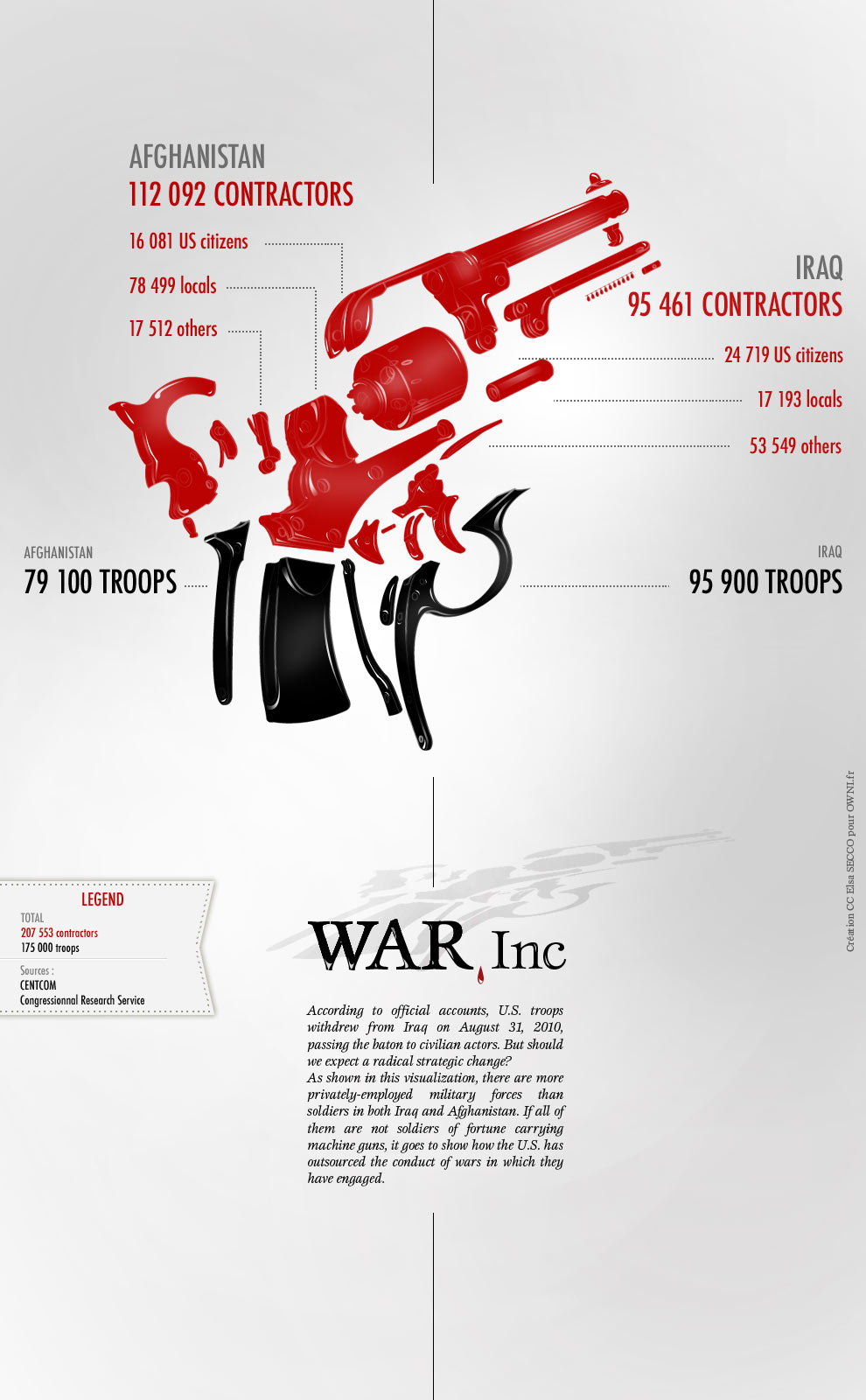
[Infographic] War Inc. » Article » OWNI.eu, Digital Journalism
[Infographic] War Inc.
The dramatic superiority of privately employed contractors over American soldiers in Iraq and Afghanistan begs important questions on the way these too conflicts were conducted.
À propos de l'auteurPilote de char russe reconverti /-)
Related postsAccording to official accounts, US troops withdrew from Iraq on August 31, 2010, passing the baton to civilian forces. Does this mean we should expect a radical change in strategy? As this infographic shows, there are more privately-employed military sources than soldiers in both Iraq and Afghanistan. Assuming not all of them are ’soldiers of fortune’, carrying machine guns, it goes to show the US has outsourced the conduct of wars in which it has engaged.
Infographie réalisée par Elsa Secco

 email
email  -->
-->
Warlogs: European Collaborative Investigation App » Article » OWNI.eu, Digital Journalism
Warlogs: European Collaborative Investigation App
Given the huge amount of data made available by Wikileaks, we developed an application allowing you to review the files potentially revealing information about coalition forces. We need you !
À propos de l'auteurPilote de char russe reconverti /-)
Related posts
Last Sunday, the whistle-blowing website Wikileaks – along with 3 major media outlets (The New York Times, UK’s Guardian and Germany’s Der Spiegel) – unveiled crucial documents about the war in Afghanistan. More than 90,000 classified military reports have been made available to the public and draw an unprecedented picture of how the war has been conducted by US and ally forces.
In short, it appears that on several occasions during the course of the Afghan War, US and allied military forces have covered up civilian casualties. The role of several paramilitary militias has also been revealed by the so-called “war diaries” (LINK). Among them, the Task Force 373 was charged of chasing and hunting down insurgent leaders : some reports led authorities to question the legality of such army corps.
The documents also shed light on the ambiguous role of the Pakistanese intelligence service, that is now said to provide weapons, funds and assistance to Taliban insurgents, despite the official support of Pakistani government to the allied coalition. Reports also pointed out that insurgents were better armed than reported by the US army.
Julian Assange and his collaborators are still holding back over 15,000 not yet published documents for security and double-checking purposes, that are likely to be published in the coming months.
But this leak is a groundbreaking event opening up a new path in the way news are reported. The so-called ‘joint venture’ between three major news organisation, who were able to perform “slow journalism” and data-journalism before breaking the news together at the same time, as well as the huge amount of data leaked are an opportunity that journalists from around the world have to seize.
The big issue now facing those from countries other than US and UK is that there is a massive amount of documents and of complex data to go through in order to get a picture of what is going on for each country. Wikileaks itself has only been able to check a small part of the whole amount of data.
That is why the OWNI crew decided to create and develop an online application enabling people to crowdsource the journalistic work. You will be provided a tool to review and assess the countless reports and documents remaining unclear. Once we will have collected enough data and analysis, we will be able to provide you with new insights and understandings of the situation.
Wanna get your hands dirty, exploring what your taxpayer’s money is used in Afghanistan and going through a huuuuge amount of data ? We are already waiting for you /-)
Pour les francophones, l’application en Français est disponible ici et l’article de cette application.
__
FlickrCC Photo Credits : Dvdis.


Hacks/Hackers Brussels Inaugural Meetup: “Give Us The Data”! » Article » OWNI.eu, Digital Journalism
Journalism
Hacks/Hackers Brussels Inaugural Meetup: “Give Us The Data”!
Journalists and developers launched an effort to gather information on open databases in the country and on the European Parliament and Commission last Thursday at the first Hacks/Hackers event in Belgium .
Related postsJournalists and developers launched an effort to gather information on open databases in the country and on the European Parliament and Commission last Thursday at the first Hacks/Hackers event in Belgium .
Almost 50 people attended the event in Brussels, mostly hackers, but with a strong representation from national media (such as Le Soir, RTL-TVi, RTBF *) .
The group is looking to hold their first hackaton in January. As an initial effort, the group decided to create a Google doc to collect URLs of open databases in Belgium and Brussels (European Parlement/Commission), which are lacking at the moment.
* Disclosure: I work for RTBF
——-
Photo Credits: Flickr CC damienvanachter
The post was also published on Hacks/Hackers.com


Give Us Our Data, Facebook » Article » OWNI.eu, Digital Journalism
Give Us Our Data, Facebook
it’s time for Facebook to voluntarily hand that data over to users, via an API that third party apps can use.
Related postsI usually give Facebook the benefit of the doubt in its various wars with the press and users, particularly around privacy issues. Mostly because user expectations around privacy are changing in real time. Things that were reprehensible just a couple of years ago are now considered so mainstream that even Salesforce will buy them and no one blinks.
So when Facebook redefines privacy to remove actual privacy, I take a wait and see approach.
I’ve taken the same approach on data portability. For a good two years we’ve all been waiting for Facebook to let our data out. They’ve done so in drips and drabs, but the crown jewels – user emails – remain locked up.
In 2008 Robert Scoble was actually banned from Facebook for using a Plaxo script that extracted friends’ email addresses. That was pretty hard back then and it required both screen scraping as well as optical character recognition, because the emails were displayed in images.
At the time I sided with Facebook. Mostly because screen scraping on a mass scale can destabilize sites, but also because I believed that my email address was my data, not Robert’s, to take. Also, Facebook wasn’t that big back then, sometimes you need to give young startups a break so they have any chance against the big guys.
Well, that’s all changed now. And it’s time for Facebook to voluntarily hand that data over to users, via an API that third party apps can use.
Also, I’m not focusing on Google’s actions, or the very public fight going on between the two companies (summary here) over this very issue, in this post. Whether Google is right or wrong, while interesting, is a different conversation.
These are the reasons I think Facebook has to give users and authorized third party applications the ability to extract social graph information, including email addresses, from Facebook. More on each below.
1. It’s what users want, and it’s the right thing to do.
2. Facebook is so large now that health-of-ecosystem and user needs must be considered when Facebook makes product and policy decisions.
3. They’re lying to press and users, even today, about their motivations for retaining data. This is not about protecting users.
4. The data export tool they released last month is a red herring.
5. They have a very small window of opportunity to do this, before Attorneys General and class action litigators see too big of an opportunity to pass up.
It’s the right thing to do. Facebook is becoming the center of our Internet lives, more so each day. Dissatisfied users really don’t have a choice to leave Facebook any more. Giving up Facebook, for tens of millions of people at least, would be no more palatable than giving up their telephone. That means people can’t really vote with their feet any more. Facebook needs to lay the groundwork now to avoid being the focus of antitrust attention in the next decade, or attorney general/class action lawyers in the next two years. It’s the right thing to do, and it’s also the smart thing to do.
Facebook is too important. So much of the Internet’s architecture has been rewritten in the last year to leverage and exploit Facebook Connect and other Facebook data and tools that the decision is no longer really entirely theirs. There are real health-of-ecosystem issues arising that must be addressed now or the Internet as a whole will suffer. And on a user level, Facebook is already the center of their world. It is their address book, except it’s an address book that won’t let you download your information to use it in other places.
We need a user advocate sitting at the table when Facebook makes product and policy decisions. That way it won’t be about what they can get away with, it will be about what’s best for everyone. In the long run, that will make Facebook a far more valuable company, too. There should be someone at Facebook who’s job it is to piss everyone else off by always taking the user’s side. And when they win or lose battles internally they should be transparent about their position on those battles.
Facebook is lying. Facebook’s statement today boiled down to this:
“The most important principle for Facebook is that every person owns and controls her information. Each person owns her friends list, but not her friends’ information. A person has no more right to mass export all of her friends’ private email addresses than she does to mass export all of her friends’ private photo albums.”
That’s the same argument that they used two years ago with Scoble. But since then Facebook has been quite willing to allow “mass exports” of “friends’ private email addresses” if the terms are right. They did it with Microsoft, they’re doing it with Yahoo, and possibly other partners. Facebook violated their own privacy policy with the Microsoft relationship. The policy has since been updated.
The truth is Facebook doesn’t see this data as your friends’ private email addresses. They consider it their data. They own it. Literally. So when they say “A person has no more right to mass export all of her friends’ private email addresses than she does to mass export all of her friends’ private photo albums,” what they really need to do is add “, unless it’s with a partner that’s making it worth our while.”
The data export tool red herring. Last month Facebook started letting users download most of their Facebook data, and many people point to that as a sign they are opening up. Nonsense. All that data is nice, and it’s helpful to be able to download it. But it is not usable by third parties in any automated way, and it doesn’t include friend email addresses. You couldn’t use it to export all your photos to Flickr, for example. That means it’s a nice PR product, but it doesn’t address the core problem at all.
Small window of opportunity. There are companies with unlimited resources putting pressure on politicians with unlimited ambitions to do something about this. If Facebook moves now they get credit for being decent. If they wait, things get ugly for them, with the same result. At this point Facebook has already won this war twice over – being magnanimous won’t hurt them competitively, and it will help their image.
—-
This article originally appeared on TechCrunch

The militarization of the Internet » Article » OWNI.eu, Digital Journalism
The militarization of the Internet
Retrofitting the web to make it fit law enforcement’s (or national security’s) “authentication” needs would be an enormous, retrograde step.
Related postsProfesseur at Cardozo Law School in New York City, Susan Crawford was, until December 2009 President Barack Obama’s Special Assistant for Science, Technology, and Innovation Policy.
__
Someone needs to take a good hard look at those Internet surveillance stories being strategically placed on the front page of the New York Times.
There’s a trail here, I believe, that’s worth following. Here are some data points:
1. Cyberattack – there appears to be a deep interest in the ability to declare war online, as evidenced by cybersecurity research and public speeches by Herbert Lin, a key player who has worked on several cybersecurity reports for the National Research Council. Ethan Zuckerman has summarized a presentation by Lin, which included the following paraphrase of Lin’s remarks:
If we’re interested in pre-empting cyber attack, “you need to be in the other guy’s networks.” But that may mean breaking into the home computers of US citizens. To the extent that cloud computing crosses national borders, perhaps we’re attacking computers in multiple jurisdictions. Lin wonders whether a more authenticated internet will actually help us to pre-empt attack. And he reminds us that US Strategic Command asserts authorization to conduct “active threat neutralization” – i.e., logging into your machine to stop an attack in progress. . . .
Dr. Lin notes that it’s not a violation of international law to collect intelligence abroad. It’s possible to engage in covert action as regulated by US statute. And there’s an array of possible responses the US could launch in response to cyberattack (Lin pauses to note that he’s not advocating any of these) – we could attack enemy air defenses, hack their voting machines to influence an election, conduct campaigns of cyberexploitation to spy within those nations. Given all this, aren’t nations entitled to fear the consequences of a “free and open” internet? Might they reasonably choose to tighten national control over the internet?
2. A “more authenticated Internet” would obviously include using the leverage provided by network operators to permit only fully-authorized, identified machines to connect. The ability to remotely disconnect machines or devices until they are cleansed is now within reach for federal networks – this same capability will inevitably spread to private connections.
3. A “more authenticated Internet” would also include more-easily tappable applications as well as machines. That’s what FBI Director Mueller is talking about in this video at 3:29.
4. There must be deep stress inside the USG re what the overall public position of the Administration will be on enhancing surveillance, authentication, and the ability to declare war online. Secretary Clinton’s “Internet Freedom” speech of January 2010 made clear that the free flow of information online is an important component of the nation’s foreign policy.
Internet is not like the telephone
5. Given this stress, the agencies that are most interested in forwarding cyberattack abilities, surveillance, guaranteed back doors for encrypted communications, and all the other trappings of a “more authenticated Internet” have an interest in portraying their vision of the future Internet as inevitable. Part of that campaign would logically be to get the story into the mainstream media.
6. So, here we go – another front-page story yesterday in The Times: “Officials Push to Bolster Law on Wiretapping.” This is a hugely contentious issue. Should law enforcement be able to require all technologies online to have “back doors” allowing officials to (essentially) require that the same information be produced to them that was produced during the circuit-switched telephone era?
7. The Internet is not the same thing as a telephone network. It’s a decentralized agreement to route packets of information to particular addresses. It has made possible unparalleled innovation, free speech, and improvements to human lives around the world. Retrofitting it to make it fit law enforcement’s (or national security’s) “authentication” needs would be an enormous, retrograde step.
But it would certainly help us wage war online.
This post originally appeared on Susan Crawford’s blog
__
Photo Credits: Flickr CC jurvetson, randy.troppmann

http://owni.eu/2010/10/30/the-militarization-of-the-internet/
Suppressed history of FBI #Cointelpro war on ’We the people’ | Examiner.com
Suppressed history of FBI Cointelpro war on 'We the people'
Related articles
In the Cointelpro Documentary Part 1 (below), evidence is presented of the suppressed history of the FBI Cointelpro's (COunterIINTELigencePROgram) sabotage of legitimate dissent and persecution of people of color that is a component of spying. Information about this government program has been as suppressed as the associated history of Nazis in the highest U.S. government echelons leading the white supremacy movement in the U.S.
Surveillance, informants, sponsoring discrediting letters signed by phony names sent to family members to dissolve family support, blocking meetings with individuals who could further an individual's success in bettering humanity, death threats and assassinations are only some of the covert tactics that have destroyed American freedom and justice defenders for decades and continue through today
Cointelpro has had over fifty years to refine its violent operation. Now under a different name, it targets individuals on both sides of the party fence, people as innocent as Reverend Martin Luther King who had all of the above-mentioned tactics used against him by his own government.
Rev. King, a candidate of the black "Messiah," was assassinated on April 4, 1968. Tens of thousands of FIPs remain in prison due to Coitelpro.
Secret government spying crimes unleashed during the Bush administration follow a pattern based on advanced surveillance technology. Once a target is chosen, he or she is “put under covert surveillance in their residence, car, place of employment and anywhere else“ according to a targeted man, Robert Wood.
Former U.S. Ambassador to the United Nations, Rev. Andrew Young stated that the problem is, "a neo-fascist police state mentality that pervaded the intelligence community and is a danger to the US to this day."
Deborah Dupré, B.S., M.S., DipConEd, has been a human and civil rights advocate for over 25 years in the U.S., Vanuatu and Australia. Feel free to support her work and book in progress about targeted individuals at www.DeborahDupre.com , by subscribing to Dupré's reports, and by posting the link to this site unless republishing permission is granted. (Email info@DeborahDupre.com.) Dupré's most recent book, Operation H1N1: Vaccine Liberty or Death, is available at DeborahDupre.com.
U.S. Scans Afghan Inmates for #Biometric Database | #ABIS #HIDE #BAT #BATS #RFID
U.S. Scans Afghan Inmates for Biometric Database
- By Spencer Ackerman

- August 25, 2010 |
- 12:37 pm |
- Categories: Af/Pak
BAGRAM AIR FIELD, Afghanistan — Don’t think of the U.S. military’s new Detention Facility In Parwan as just a holding pen for suspected insurgents. It’s also an emerging datafarm, storing biometric information on its inmate population. In a country with a shaky commitment to the rule of law, those identifiers could become weapons.Parwan, with its thousand-or-so detainee population, will become an Afghan-run detention complex next year. By 2014, it’ll become a major Afghan jail, run by the Ministry of Justice to incarcerate convicted criminals, not hold insurgents taken off the battlefield. But Army Brigadier General Mark Martins, who currently runs day-to-day operations at the detention center, explains that there’s a basic problem with Afghanistan’s criminal justice system: It doesn’t have a efficient information infrastructure to identify the people it holds. That’s where he comes in.
Every detainee who comes into Parwan leaves basic information with the Detainee Services Branch during in-processing: Name; father’s name; residence. A mark of any identifying scars, marks or tattoos. Residence of record. After a shower and a medical exam, the DSB scans their irises and collects prints from all of their fingers, rolling their thumbs for a 360-degree view. Its cameras snap five photographs of every detainee’s face. All of this information goes into a military database called the Automated Biometric Information System.
Troops in the field can access the system through a set of portable consoles that the DSB has on hand. The Biometrics Automated Toolset, or BAT, allows troops who detain insurgents on the battlefield to get a quick biometric identification of who they’ve captured, all through talking to the database. One clunky component of it, the Handheld Interagency Identity Detection System (HIIDE), which looks like a big black FunSaver, takes pictures of a captive’s irises, facial features and fingerprints. BATS and HIIDE were used in Iraq, where counterinsurgents like David Kilcullen praised the devices for allowing troops to quickly and positively identify known insurgents during the surge.
But any detective will tell you that a database is only as good as the data it contains. And after 30 years of war, Afghanistan isn’t really in the data-collection game. The U.S. military’s detentions command, known as Joint Task Force-435, is working with the Afghan Ministry of Interior to kick-start an up-to-date records program.
Martins says he and the ministry want “enrollments on 15 percent of fighting-age males,” Afghans between the ages of 14 and 49. Studies that he’s seen convince him that 15 percent represents a Gladwellian tipping point, allowing the U.S. and the Afghans to match exponentially more latent fingerprints off homemade bombs to Afghans in the system.
But that means biometric information about one million people. And the easiest way to get this information is by locking up a whole lot of Afghans and collecting it against their will, one of the reasons that human rights advocates are wary about the U.S.’s plans to turn over Parwan to the Afghans.
In Iraq, privacy advocates raised similar concerns about weaponizing the biometrics database — essentially, turning it into a military hit list. Afghanistan is filled with corruption, fraud and malicious police officers. Its commitment to the rule of law is, to be charitable, immature. In such a circumstance, a counterinsurgency tool like the biometric database just as easily become predatory, allowing its possessors to take out their political or ethnic rivals and reward their allies. If the WikiLeaks disclosures put Afghans in danger, imagine what iris scans and fingerprints could mean for people who don’t want to pay bribes to crooked cops.
“That’s a policy-significant issue,” Martins admits, “Who holds the data?” According to an October memorandum signed by the U.S. and Afghan governments, the Afghans will. The U.S. might see its collected records become the “biometric component of a national ID” Martins says, good for property ownership records, establishing credit lines and other economic behavior. But first, the biometrics database will be “MOI’s data,” in the hands of the security services — the legacy of ten years of U.S. detention operations in Afghanistan.
Credit: DoD Biometrics
See Also:
