Issues
Recent Blog Posts
Access denied
You are not authorized to access this page.
https://www.cdt.org/job/job-opportunity-national-security-law-fellow
And the Privacy Invasion Award Goes To …
Who’s playing fast and loose with your data? The Big Brother Awards, billed as the “Oscars for data leeches” by the hackers and privacy advocates who hand out the prizes, shine a high-intensity spotlight on companies and individuals with poor privacy track records. Since 1998, Privacy International and a host of affiliated organizations have singled out the worst privacy violators in various countries including the UK, Austria, France, Switzerland, Denmark, Belgium, Japan, New Zealand and the U.S. The title evokes the totalitarian cult personality featured in George Orwell’s 1984, set in a dystopic world of mass surveillance.
In Germany, privacy advocates held their annual edition of the Big Brother Awards in April. The panel of judges was made up of representatives from privacy advocate FoeBuD and other organizations campaigning for data protection and human rights. Curious to know who made Germany’s list of privacy offenders? Here’s the rundown.
Markus Ulbig, Saxon Minister of the Interior
Markus Ulbig, Saxon Minister of the Interior, snagged a Big Brother Award in the category “Government and Administration” for presiding over a veritable data tsunami that swept up mobile phone data belonging to hundreds of thousands of law-abiding citizens. Police filed data requests with cell phone service providers for connection logs over a 12-hour period in Dresden, resulting in the staggering release of more than a million phone records associated with some 55,000 identified subscribers. The requests were filed in the wake of a February 2011 mass demonstration against a Dresden Nazi parade. The police were targeting the anti-Nazi protesters.
The Cloud
“The Cloud” won a Big Brother Award in the communication category, with the panel of judges characterizing it as “a trend that deprives users of control over their own data.” Almost all cloud storage providers are American companies, they point out, and are therefore obliged by the Foreign Intelligence Surveillance Act (FISA) to allow US authorities access to all data, even if the server farms are situated on European soil. EFF hit on this point when we mentioned that the US Department of Justice (DOJ) “seems to be trying to placate international concern by saying one thing in international fora; but something quite different in the US courts … The DOJ's position in its court filings is that very little, if any, privacy protection is available against US government access to the records of users of US-based cloud computing services.”
Blizzard Entertainment, Inc.
In the consumer protection category, video game company Blizzard Entertainment, Inc. won a Big Brother Award for a change of terms that raised a host of privacy concerns, including a scan of the computer’s working memory to prevent cheating, chat recording that captures text communications, game recording and player rankings that reveal how often and how long players have been playing. “Our reason to give today’s Big Brother Award is the full interaction between numerous components, under the label ‘Real ID,’” the judges noted.
Dr. Hans-Peter Friedrich, Federal Minister of the Interior
In the “Politics” category, Dr. Hans-Peter Friedrich, Interior Minister in the German federal government, became a Big Brother Award recipient for spearheading joint security projects judges described as violations of the constitutional principle of separating the police, intelligence services and military. The projects created a "national cyber-defense center" and a defense center against right-wing extremism – both of which were established without consulting the Parliament. These security initiatives “cause police, secret services and the military to be networked and integrated in a troublesome way,” the judges wrote. “This is a violation of the German constitution’s historically rooted imperative that these security authorities must work independently and in strict separation.”
Gamma International & FinFisher
In this day and age, what technology is most deserving of a Big Brother Award? Judges settled on surveillance software produced by Gamma International subsidiary FinFisher, which made headlines last year following revelations that it had been deployed under Egyptian ruler Hosni Mubarak. One of the most controversial investigation tools marketed by FinFisher “enables government agencies to search [a personal computer’s] contents remotely and covertly, snoop through e-mails, or record passwords. Even the computer’s microphone and web cam can be activated for surveillance,” noted the Big Brother Award announcement. EFF spotlighted Gamma International as part of a profile of spy tech companies and their authoritarian customers.
Bofrost
German-based frozen foods manufacturer Bofrost earned a Big Brother Award in the “workplace” category for accessing a file on a computer belonging to the Bofrost staff council (in Germany, staff councils are “shop-floor” organizations representing employees in labor negotiations). On another staff council computer, Bofrost installed Ultra VNC – a kind of software that allows a user to display the screen of another computer on his or her own screen – without the staff council’s consent. The workplace espionage was carried out in connection with industrial law court cases, which Bofrost initiated and ultimately lost.
Brita
In the “Economy” category, water filtration company Brita GmbH was singled out for marketing water vending machines for schools that dispense water only when a student taps them with a bottle containing an RFID chip. Judges were extremely critical of the practice. They wrote, “This water bottle system is a glaring example of the industry’s attempts to establish a culture of overtechnisation, surveillance and blatant paternalism from early childhood.”
PRIVACY INVASION AWARD by @EFF http://bit.ly/K01jp6
How to Deploy HTTPS Correctly
Chris Palmer, 15 Nov 2010
Internet technologists have long known that HTTP is insecure, causing many risks to users. The release of Firesheep made one of these risks concrete and obvious to even non-technical folks.
While HTTPS has long existed as a reasonable way to improve web security, web operators have been slow to host their applications with it. In part, this is because correctly and completely hosting an application with HTTPS takes some care.
This article is designed to help web operators get a conceptual handle on how to protect their users with HTTPS. Taking a little bit of care to protect your users is a reasonable thing for web application providers to do, and a good thing for users to demand.
Background
HTTPS provides three security guarantees:
- Server authentication allows the browser and the user to have some confidence that they are talking to the true application server. Without this guarantee, there can be no guarantee of confidentiality or integrity.
- Data confidentiality means that eavesdroppers cannot understand the communications between the user’s browser and the web server, because the data is encrypted.
- Data integrity means that a network attacker cannot damage or alter the content of the communications between the user’s browser and the web server, because they are validated with a cryptographic message authentication code.
HTTP provides no security guarantees, and applications that use it cannot possibly provide users any security. When using a web application hosted via HTTP, people have no way of knowing whether or not they are talking to the true application server, nor can they be sure attackers have not read or modified communications between the user’s computer and the server.
Modes of Attack and Defense
However users connect to the Internet, there are a variety of people who can attack them—whether spying on them, impersonating them, tampering with their communications, or all three of these. The wifi network operator can do this; any ISP in the path between client and server can do it; anyone who can reconfigure the wifi router or another router can do it; and often, anyone else using the same network can do it, too.
Firesheep is a passive network attack: it eavesdrops on the contents of network communications between browser and server, but does not re-route or modify them.
By contrast, other freely-available tools perform active network attacks, in which the attacker does modify the contents of and/or re-route communications. These tools range from serious, such as sslstrip, to silly, like the Upside-Down-Ternet. Although Upside-Down-Ternet is a funny prank, it is technically identical to potentially more damaging attacks such as an attack that injects malicious code or incorrect information into web pages; at the same time, it shows that such attacks are easy enough to be jokes. Free wifi hotspots have been known to inject advertisements dynamically into web pages that users read—indicating that active network attacks are a viable business model. Tools like Cain and Abel enable a range of attacks, including re-routing local network traffic through the attacker's system. (Also see Arpspoof and dsniff.)
Only a mechanism that provides (at least) authentication, confidentiality, and integrity can defend against the full range of both passive and active attacks. HTTPS is currently our best option for web applications.
However, there are some potential pitfalls that site operators must avoid.
Mixed Content
When hosting an application over HTTPS, there can be no mixed content; that is, all content in the page must be fetched via HTTPS. It is common to see partial HTTPS support on sites, in which the main pages are fetched via HTTPS but some or all of the media elements, stylesheets, and JavaScript in the page are fetched via HTTP.
This is unsafe because although the main page load is protected against active and passive network attack, none of the other resources are. If a page loads some JavaScript or CSS code via HTTP, an attacker can provide a false, malicious code file and take over the page’s DOM once it loads. Then, the user would be back to a situation of having no security. This is why all mainstream browsers warn users about pages that load mixed content. Nor is it safe to reference images via HTTP: What if the attacker swapped the Save Message and Delete Message icons in a webmail app?
You must serve the entire application domain over HTTPS. Redirect HTTP requests with HTTP 301 or 302 responses to the equivalent HTTPS resource.
Some site operators provide only the login page over HTTPS, on the theory that only the user’s password is sensitive. These sites’ users are vulnerable to passive and active attack.
Security and Cookies
As I described in a paper on secure session management for web applications, site operators must scope sensitive cookies (such as cookies used for user authentication) to the secure origin. If a cookie is broadly scoped (with the Domain attribute in the Set-Cookie: header), it may “leak” to other hosts or applications in the same domain—potentially less-secure hosts or applications.
Similarly, the application must set the Secure attribute on the cookie when setting it. This attribute instructs the browser to send the cookie only over secure (HTTPS) transport, never insecure (HTTP).
Use HTTP Strict Transport Security
HTTP Strict Transport Security (HSTS) is an HTTP protocol extension that enables site operators to instruct browsers to expect the site to use HTTPS.
Although not all browsers yet support HSTS, EFF urges those that don’t—we’re looking especially at you, Apple and Microsoft—to follow the lead Google and Mozilla have set by adopting this useful security mechanism. Indeed, ultimately we expect HTTPS (and possibly SPDY) to replace HTTP entirely, the way SSH replaced Telnet and rsh.
We recently enabled HSTS for eff.org. It took less than an hour to set up, and we found a way to do it without forcibly redirecting users to HTTPS, so we can state an unequivocal preference for HTTPS access while still making the site available in HTTP. It worked like a charm and a significant fraction of our users are now automatically accessing our site in HTTPS, perhaps without even knowing it.
Performance Concerns
Many site operators report that they can’t move to HTTPS for performance reasons. However, most people who say this have not actually measured any performance loss, may not have measured performance at all, and have not profiled and optimized their site’s behavior. Usually, sites have latency far higher and/or throughput far lower than necessary even when hosting over HTTP—indicating HTTPS is not the problem.
The crux of the performance problem is usually at the content layer, and also often at the database layer. Web applications are fundamentally I/O-bound, after all. Consider this wisdom from the Gmail developers:
First, we listed every transaction between the web browser and Google’s servers, starting with the moment the “Sign in” button is pressed. To do this, we used a lot of different web development tools, like Httpwatch, WireShark, and Fiddler, plus our own performance measuring systems. [...]
We spent hours poring over these traces to see exactly what was happening between the browser and Gmail during the sign-in sequence, and we found that there were between fourteen and twenty-four HTTP requests required to load an inbox and display it. To put these numbers in perspective, a popular network news site’s home page required about a 180 requests to fully load when I checked it yesterday. But when we examined our requests, we realized that we could do better. We decided to attack the problem from several directions at once: reduce the number of overall requests, make more of the requests cacheable by the browser, and reduce the overhead of each request.
We made good progress on every front. We reduced the weight of each request itself by eliminating or narrowing the scope of some of our cookies. We made sure that all our images were cacheable by the browser, and we consolidated small icon images into single meta-images, a technique known as spriting. We combined several requests into a single combined request and response. The result is that it now takes as few as four requests from the click of the “Sign in” button to the display of your inbox.
Google’s Adam Langley provides additional detail:
In order to do this we had to deploy no additional machines and no special hardware. On our production frontend machines, SSL/TLS accounts for less than 1% of the CPU load, less than 10KB of memory per connection and less than 2% of network overhead. Many people believe that SSL takes a lot of CPU time and we hope the above numbers (public for the first time) will help to dispel that. [emphasis in original]
Is it any wonder Gmail performs well, even when using HTTPS exclusively? Site operators can realize incremental improvement by gradually tuning their web applications. I gave a presentation to this effect at Web 2.0 Expo 2009.
Conclusion
HTTPS provides the baseline of safety for web application users, and there is no performance- or cost-based reason to stick with HTTP. Web application providers undermine their business models when, by continuing to use HTTP, they enable a wide range of attackers anywhere on the internet to compromise users’ information.
More to Come
Keep an eye out for Part Two of this whitepaper, which will go into more detail about how site operators can easily and incrementally improve site efficiency, thus enabling the move to HTTPS.
HTTPS Everywhere Rulesets
This page describes how to write rulesets for HTTPS Everywhere, the Firefox plugin that switches sites over from http to https automatically. HTTPS Everywhere comes with thousands of rulesets, but you might want to edit them, or write new ones.
[We believe this information is correct as of version 2.0 of HTTPS Everywhere.]
Rulesets are simple xml files. Here is a simplified version of Twitter.xml, from the plugin distribution:
The "target" tag specifies which domains the ruleset might apply to. The target host tag does not use regular expressions. The content of a target tag should be the actual name of a web server to which the ruleset applies or partially applies, like www.eff.org, www.google.com, secure.wikimedia.org, and so on. If your rule applies to the domain itself (like "eff.org", not just "www.eff.org"), you need an additional target tag to say so. For example, the sample ruleset above is meant to apply to either www.twitter.com or twitter.com, so it has a separate target tag for each.
A target may, however, contain a wildcard in one portion of the domain (like *.google.com or google.*, but *.google.* would not work). A wildcard on the left will match arbitrarily deep subdomains (for instance, *.facebook.com will match s-static.ak.facebook.com).1
The "rule" does the actual rewriting work. The "from" and "to" clauses in each rule are JavaScript regular expressions. You can use them to rewrite URLs in more complicated ways. Here's a simplified example for Wikipedia:
That rewrites a URL like http://fr.wikipedia.org/wiki/Chose to https://secure.wikimedia.org/wikipedia/fr/wiki/Chose. Notice, again, that the target is allowed to contain (just one) * as a wildcard meaning "any".
It is possible to add exclusions. An exclusion specifies a pattern, using a regular expression, for URLs where the rule should not be applied. The EFF rule contains one exclusion, for a domain that is hosted externally and does not support HTTPS:
Note that if your rules include ampersands (&), they need to be appropriately XML-encoded: replace each occurence of & with &.
Lastly, because many HTTPS websites fail to correctly set the secure flag on authentication cookies, there is a facility for turning this flag on. For instance:
The "host" parameter is a regexp specifying which domains should have their cookies secured; the "name" parameter is a regexp specifying which cookies should be secured. Note that HTTPS Everywhere will only secure a cookie when it is set over HTTPS.
Once you've written a ruleset, you can use and test it by placing it in the HTTPSEverywhereUserRules/ subdirectory in your Firefox profile directory, and then restarting Firefox. While using the rule, check for messages in the Firefox Error Console to see if there are any issues with the way the site supports HTTPS. Note that it is inadvisable to edit the builtin rules in-place, since they will be overwritten by upgrades to the extension. Either keep your edits in a safe place, or use a git repository.
If you've tested your rule and are sure it would be of use to the world at large, send it to the rulesets mailing list at https-everywhere-rules AT eff.org. Please be aware that this is a public and publicly-archived mailing list. NOTE: many rules that are not yet distributed in the official version of HTTPS Everywhere are already in our git repository! Before sending us a new rule, please check there to see if your rule has already been submitted by someone else.
Note that there are currently hundreds of pending rules which are not present in the latest stable version but which are included in development builds. If a version of the rule you're interested in is found in the relevant part of our git repository, you don't need to write a new one -- just switch to the the development branch or build your own .xpi from git.
make-trivial-rule and trivial-validate.py
As an alternative to writing rules by hand, there are scripts you can run from a Unix command line to automate the process of creating a simple rule for a specified domain. These scripts are not included with HTTPS Everywhere releases but are available in our development repository and are described in our development documentation.
Disabling a ruleset by default
Sometimes rulesets are useful or interesting, but contain some bugs or issues that make them unsuitable for being enabled by default in everyone's browsers. For instance, the HTTPS website may use a Certificate Authority that is not trusted by everyone's browsers (most commonly, CAcert or a self-signed certificate). Or the ruleset may successfully secure parts of a site but interfere with others.
In such cases, rulesets should be disabled by default. This is done by adding a default_off attribute to the ruleset element, with a value explaining why the rule is off.
By convention, you should add a parenthetical to the name of the ruleset — like (buggy) while it is off. If you reenable a ruleset, you should remove the parenthetical. This convention is important: it exists so that the change to the default override existing users' settings for whether the ruleset is on or off.
Disabling a ruleset on some platforms
Sometimes bugs on a platform may mean that a ruleset should be off by default on that platform only. For instance, this bug caused us to temporarily disable the Google Translate rules on Chromium and Chrome. This can be achieved with the "platform" attribute:
Platform is a space-delimited list of platforms on which the ruleset works. Currently anticipated values are "firefox", "chromium", and "cacert". If the platform attribute is present, but does not match the current platform, the ruleset will be treated as off-by-default.
- 1. Exception: currently this is not true for a target host that is less than three levels deep. would match thing.com but not very.thing.com. We would consider changing that if anybody needs to use it. means a ruleset should be tested for every single URL.
The Greatest Gift, My Deepest Regret: Pepe's Final Gift: The Gift of Goodbye
I wish people would care as much about their children as I do about my pets.I never even planned to get attached to Spotty. I already had one cat and had no interest in getting another. However, I agreed to hold on to her took her for one of my clients because he was not permitted to have pets while in foster care. That was 2002.
So even though I know that child will come back for her, I do feel in someway I made a promise to a child that I can't keep. I aide a promise to Spotty that I have already broken. So I guess this is goodbye again. And the only thing worse than saying goodbye, is having to no idea what will happen to her. Omg... this is almost too painful to write.
It has been months since I posted the first "ad?" trying to find a home for Spotty. I thought for sure somebody, anybody, would be willing to hold onto to her for a couple of months.
Yest here we are 4 months later, and I have to live with the fact that I am now "that" person. The person who abandons their own children, or leaves an animal behind when the move. I am "that" person.
I have already done the research. There are very few"low kill" shelters in Tennessee. The fact that they even classify them as "low" kill makes me want to throw up. But that's the reality.
I really hate this world.
No one gives a shit about the kids who are already here living in poverty, foster homes, on the streets, or anyway the can to survive. So who gives a shit about a few people who at least have the luxury of a quick painless death rather than having it drained out of them day by day; tear by tear, year after year after year after year.I don't want to get rid of Spotty. I don't want her euthanized when I feel her little head nuzzled against my neck. She is not sick, she is not, her only crime is belonging to me. What the fuck with this world. we can through puppies into plastic bags and freeze them to death because it is "easier" than "putting them to sleep."
So yeah, there you have it. I fucked up again. How ironic that the one thing I don't have is the only thing people seem to want from me. I can't wait to hear about this one. I am 36 years old. I am not a child. I am not a criminal. I am not cruel. I have no answers for you. I do not have the resources that most people take for granted.
Why must they take the one thing I love-- the one thing that loves me. Does it make it all better for everybody else? dad, I learned my lesson. I have accepted the hand I have been dealt.
I'm not stupid, and I know that I can't blame my mom for this one since I'll be the one to drive her to the shelter tomorrow.
What the fuck is wrong with me?
If I say I'm sorry, would that make it okay for me to keep Spotty? Will someone please tell me what I need to say because I'm not sure what I did.
I'm old enough to know that nobody is coming to save me. I don't even brother to ask but why must an innocent animal who did not ask for this be the ultimate punishment for a sin I don't remember committing.
So where does Spotty go? To the farm with Abby & Ollie during divorce number two and custody battle number 4? Will my father mail me some fake ashes out of the fire place. Will my mommy drive her out to Suffolk County so she can use an assumed name like "Harrison" so I can't locate her? At least I found Pepe. I can only hope that one day I'll find Spotty.
Special message to two "special" people: Mom, I hope some takes Ziggy from you. The same way you took Pepe to that shelter in Suffolk County during the darkest moment of my life. I remember what you said, and what you were told by 3 separate mental health professionals. In fact, they remember too, because they found the your actions to be so far beyond the scope of rational behavior, they documented the entire thing. In fact, once Pepe was located, they kept a copy of the "adoption papers" in my medical records both as a precaution and as relevant family history.
Dad? Well, whatever. I can't think of anything care enough about to lose-- so enjoy. You win. I surrender. Whatever. I guess you'll tell what I'm supposed to do because that worked so well with my last Landlord.
Why can't I just live a life without empathy? I guess if you don't love anything but yourself, you will never know grief.Well now I'm really fucked, because I'm not all fond of myself these days. Don't worry, you don't need to call parents, they already know, and they couldn't care less. In fact they'll probably bill you for wasting there time. Besides, unless you went Harvard, Yale or Princeton they don't give a shit what you think. So join the club.
Just remember this: Spotty didn't chose me. I chose her. So here we go again... because apparently there is not a single person I know who is willing to save Spotty.Actually, that sounds about right. I know exactly how she feels.
Pepe's Final Gift: The Gift of GoodbyeSent via BlackBerry from T-Mobile
Many years back I had the most vivid nightmare, that 16 years later I can still remember the details of my worst nightmare:
I am standing in a sea of unfamiliar faces. There is violence everywhere. Red. Broken. Bleeding.
I am holding Pepe, and he is broken. Bleeding. Clinging to me, clinging to life. I rush through the crowd looking for safety. There is no way out. Just angry faces in a sea of violence.
In the distance, I see two police officers. I run to them believing they will help me find a way out of the madness. Believing they will bring me to safety. A safe haven. Shelter from the storm. Free from the madness. Free from the violence. Free from this sea of unfamiliar faces so I can get my bleeding, broken, suffering friend the help he needs to make him well. The help we need to be whole again.
When I reach the podium, the men were facing the crowd. They were standing there, backs to me; they just stood there to face to the crowd banging their black, wooden night sticks while on just standing there Beating their night sticks against their palms. I call out but no one listens. No one can hear me above the roar of the crowd. So I tap them on the shoulder, holding Pepe close to my heart— hoping they will instinctively see the love and fear in his yellow gold eyes. Of course, they would rescue us. Yes, they would rescue us and bring us to safety. Free from the violence, free from the madness. Free from this hell and take us somewhere safe. Somewhere far, far away from here. And then they turn. In unison, they turn around to face me, and I look at them. I am horrified. I am horrified because these are not police officers at all. They are clowns. Literally, figuratively, in every way they are simply clowns. Clowns in uniform. In unison. In unanimity. Inhumanity. My worst nightmare. The cops were clowns.
Pepe was “only” a cat, but I made him a promise that I intended to keep. I would give him everything I longed for: keep him safe, keep him fed, make him well, I would give him love. Lots and lots of love. Unconditional love. Always. Until the day my perfect little angel would return to heaven. And I did. And he did. And we did. Alone, together, Pepe gave me strength when I was too weak to care for myself. He could not talk, but he sure tried!
After seventeen years, Pepe died the other day, and my worst nightmare did not come true. I loved him until the very end. Even then he gave me the most perfect and fitting gift. He gave me freedom. He gave me comfort. He gave me hope and he gave me peace.
I know that I can love. I am capable of complete, total, unconditional love. He was like a child. Pure, innocent and completely, totally, unconditionally loved. Yes, I am capable of love. I am capable of complete, total, and unconditional love. Pepe, my precious angel, may you rest in peace… There is a better place for you now. There always was.Labels: Dark Night, Ethics, EyePhobic, IM Phobic, Karma, Twitter Chatter, White Noise
retro post -- see... you can hack but you can't hide.
"I will not be ignored, I wil not be forgotten."
~ELyssa Durant, Ed.M.
11/20/2009-2011
Elyssa Durant || Copyright 2011 || All Rights Reserved
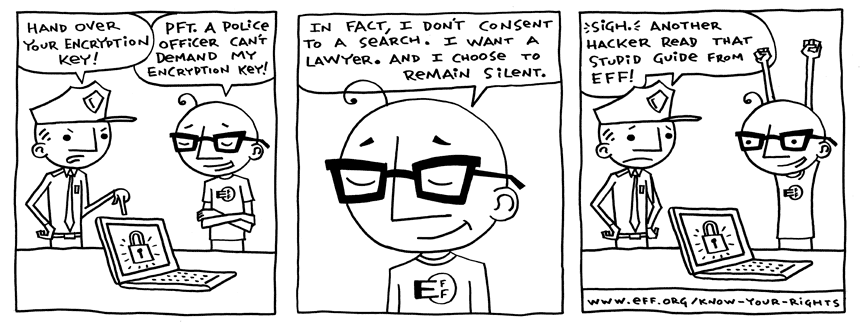
Computer Search and Seizure: A Three-Panel Cartoon
Think you know what to do when law enforcement seeks access to your digital device? Test your skills with our online quiz. Then brush up on your knowledge with our Know Your Rights whitepaper.
We also highly recommend you print our one-page guide explaining what to do when the police ask for access to your device. Leave it by your workstation, tape it up in your server room, and slip a copy into your laptop case—anywhere you have sensitive information on a digital device.
Posted via email from pwned
Cell Phone Guide for Occupy Wall Street Protesters (and Everyone Else)
Occupy Wall Street has called for a global day of action on October 15, and protesters are mobilizing all over the world. In the United States, the Occupy Wall Street movement has already spawned sizeable protests in New York, Washington DC, Boston, Seattle, San Francisco, Oakland, Austin, and other cities. Several of these movements have faced opposition from their local police departments, including mass arrests.
Protesters of all political persuasions are increasingly documenting their protests -- and encounters with the police -- using electronic devices like cameras and cell phones. The following tips apply to protesters in the United States who are concerned about protecting their electronic devices when questioned, detained, or arrested by police. These are general guidelines; individuals with specific concerns should talk to an attorney.
1. Protect your phone before you protest
Think carefully about what’s on your phone before bringing it to a protest. Your phone contains a wealth of private data, which can include your list of contacts, the people you have recently called, your text messages, photos and video, GPS location data, your web browsing history and passwords, and the contents of your social media accounts. We believe that the police are required to get a warrant to obtain this information, but the government sometimes asserts a right to search a phone incident to arrest -- without a warrant. (And in some states, including California, courts have said this is OK.) To protect your rights, you may want to harden your existing phone against searches. You should also consider bringing a throwaway or alternate phone to the protest that does not contain sensitive data and which you would not mind losing or parting with for a while. If you have a lot of sensitive or personal information on your phone, the latter might be a better option.
Password-protect your phone - and consider encryption options. To ensure the password is effective, set the “password required” time to zero, and restart phone before you leave your house. Be aware that merely password-protecting or locking your phone is not an effective barrier to expert forensic analysis. Some phones also have encryption options. Whispercore is a full-disk encryption application for Android, and Blackberry also has encryption tools that might potentially be useful. Note that EFF has not tested these tools and does not endorse them, but they are worth checking into.
Back up the data on your phone. Once the police have your phone, you might not get it back for a while. Also, something could happen, whether intentional or not, to delete information on your phone. While we believe it would be improper for the police to delete your information, it may happen anyway.
2. You’re at the protest – now what?
Maintain control over your phone. That might mean keeping the phone on you at all times, or handing it over to a trusted friend if you are engaging in action that you think might lead to your arrest.
Consider taking pictures and video. Just knowing that there are cameras watching can be enough to discourage police misconduct during a protest. EFF believes that you have the First Amendment right to document public protests, including police action. However, please understand that the police may disagree, citing various local and state laws. If you plan to record audio, you should review the Reporter’s Committee for Freedom of the Press helpful guide Can We Tape?.
3. Help! Help! I’m being arrested
Remember that you have a right to remain silent -- about your phone and anything else. If questioned by police, you can politely but firmly ask to speak to your attorney.
If the police ask to see your phone, you can tell them you do not consent to the search of your device. They might still legally be able to search your phone without a warrant when they arrest you, but at least it’s clear that you did not give them permission to do so.
If the police ask for the password to your electronic device, you can politely refuse to provide it and ask to speak to your lawyer. Every arrest situation is different, and you will need an attorney to help you sort through your particular circumstance. Note that just because the police cannot compel you to give up your password, that doesn’t mean that they can’t pressure you. The police may detain you and you may go to jail rather than being immediately released if they think you’re refusing to be cooperative. You will need to decide whether to comply.
4. The police have my phone, how do I get it back?
If your phone or electronic device was illegally seized, and is not promptly returned when you are released, you can file a motion with the court to have your property returned. If the police believe that evidence of a crime was found on your electronic device, including in your photos or videos, the police can keep it as evidence. They may also attempt to make you forfeit your electronic device, but you can challenge that in court.
Cell phone and other electronic devices are an essential component of 21st century protests. Whether at Occupy Wall Street or elsewhere, all Americans can and should exercise their First Amendment right to free speech and assembly, while intelligently managing the risks to their property and privacy.
the DailyDDoSe will be addressing this issue later on... I was stopped a few yards from my home yesterday morning by two large men who demanded my cell phone. I spoke with several legal authorities about this issue which currently under review. To be continued...
Posted via email from pwned
The History of FISA
As stated above, the government was free to wiretap whenever it wanted to in law enforcement investigations until the Supreme Court addressed the issue in 1967, and Congress passed the Wiretap Act in 1968. Similarly, the legality of warrantless searches and wiretaps in national security investigations, as opposed to law enforcement investigations, wasn't settled until the seventies.
In 1972, the Supreme Court ruled on the use of wiretaps in national security cases. In that case, a group of Americans protesting the Vietnam War tried to blow up their local CIA recruiting office. Investigators collected evidence against them with a wiretap but without getting a wiretap order, and argued in court that since the investigation was for national security, the president had the authority to authorize surveillance without having to go through the courts.
The Supreme Court held that the government didn't have unlimited power to conduct surveillance without the approval of a judge just by claiming the investigation was for national security, at least when investigating domestic threats to national security (that is, threats from U.S. citizens and legal residents). It left open whether or not such warrantless surveillance was allowed when investigating foreign threats.
After this decision, and after revelations throughout the seventies that the government had been engaging in an enormous amount of unauthorized spying during the 1960s and early 1970s, Congress decided to provide a legal framework to rein in foreign intelligence investigations. The Foreign Intelligence Surveillance Act of 1978 (or "FISA"), along with later amendments to that act, created a warrant procedure for foreign intelligence investigations so that there would no longer be any foreign intelligence surveillance without court oversight.
FISA in Action
FISA requires the government to get search warrants and wiretap orders from a court even when it is investigating foreign threats to national security. However, the FISA process is different from the law enforcement processes described in earlier sections.
First, all government requests for foreign intelligence surveillance authorization are made to a secret court: the FISA court. In order to get authorization, a significant purpose of the surveillance must be to gather foreign intelligence information — information about foreign spies, foreign terrorists, and other foreign threats — instead of evidence of a crime.
Most importantly, the probable cause standard is very different. Instead of having to show probable cause that a crime is being, has been, or will be committed, the government must show that the target of the surveillance is a foreign power or an agent of a foreign power.
Also unlike law enforcement surveillance, the target is never told by the government that he/she was spied on, and every person that is served with a FISA search warrant, wiretap or pen/trap order, or subpoena is also served with a gag order forbidding them from every telling anyone about it except their lawyer.
Foreign Powers and Their Agents. So, what exactly qualifies as a foreign power or agent of a foreign power when it comes to FISA surveillance? It's a bit unclear. The FISA law defines those terms only vaguely, and without any access to the decisions of the secret FISA court, there's no way of telling how broadly or narrowly the definitions are being interpreted.
According to FISA, a Foreign Power is defined to include:
- Any foreign government or component of a foreign government, whether or not officially recognized by the United States
- Any "faction" of a foreign nation or nations, or any foreign-based political organization, that isn't "substantially" composed of United States persons ("faction" and "substantially" aren't defined; a U.S. person is a citizen or a legal resident of the U.S.)
- Any entity, like a political organization or a business, that is directed or controlled by a foreign government
- Any group engaged in, or preparing to engage in, "international terrorism." ("International terrorism" is broadly defined as activities that (1) involve violent acts or acts dangerous to human life that are a violation of U.S. criminal laws or would be a violation if committed in the U.S., (2) appear to be intended to intimidate or coerce a civilian population, to influence the policy of a government by intimidation or coercion, or to affect the conduct of a government by assassination or kidnapping, and (3) occur totally outside the U.S., or transcend national boundaries in terms of how they are accomplished, the people they are intended to coerce or intimidate, or the place where the terrorists operate)
According to FISA, an Agent of a Foreign Power is defined to include:
- Anyone that is not a U.S. person who is an officer or employee of a foreign power
- Anyone that is not a U.S. person who engages in "clandestine intelligence activities" (spying) in the U.S. on behalf of a foreign power or any U.S. person that does the same and may be violating the law. So, if you're not a U.S. person, you don't have to be suspected of a crime; but even if you are a U.S. person, that suspicion doesn't have to meet traditional probable cause standards
- Anyone, whether a U.S. person or not, who engages in or prepares for acts of international terrorism or sabotage
If you think that all sounds like very vague gobbledy-gook, you're right. No one really knows what these terms mean other than the FISA court, which won't release its decisions.
And it's even worse for FISA subpoenas, which can be used to force anyone to hand over anything in complete secrecy, and which were greatly strengthened by Section 215 of the USA PATRIOT Act. The government doesn't have to show probable cause that the target is a foreign power or agent — only that they are seeking the requested records "for" an intelligence or terrorism investigation. Once the government makes this assertion, the court must issue the subpoena.
Police at the door: FISA Orders and National Security LettersIf federal agents serve you with a FISA warrant or subpoena, or a National Security Letter, the advice given for regular warrants and subpoenas applies. However, FISA orders and National Security Letters will also come with a gag order that forbids you from discussing them. Do NOT violate the gag order. Only speak to members of your organization whose participation is necessary to comply with the order, and your lawyer. The constitutionality of FISA orders and especially National Security Letters is a matter of great dispute — in particular, several courts have found that the gag order that comes with a National Security Letter violates the First Amendment — and you may be able to successfully challenge the government's demand in court. If you do decide to seek counsel and do not have an a lawyer of your own, you can call the lawyers at EFF.
FISA Wiretap Statistics
Like law enforcement wiretaps, FISA surveillance is relatively rare. Also like law enforcement wiretaps, however, FISA surveillance probably sweeps in the communications of a great many people. Because the information released about FISA surveillance is so limited, though, it's impossible to gauge just how many people are affected and how many communications are intercepted. The only public data available on FISA are the numbers of applications made to, and approved by, the FISA court. And those numbers have steadily increased through the years, to the point where FISA orders now outnumber all federal and state wiretap orders combined! For example, in 2007, 2,370 applications for FISA wiretaps were granted by the FISA court, compared to 2,208 state and federal wiretaps reported in the same year. And each application can contain a request for more than one type of surveillance — for example, a wiretap, a secret search, and secret subpoenas.
Like with law enforcement wiretaps, your FISA wiretap risk is very low, as is the risk of being subjected to a secret physical search under FISA. The risk of having records about you secretly subpoenaed under FISA is much higher, but if it's your communications records the government is after, they're more likely to use a National Security Letter.
Privacy tip: Foreign Intelligence SurveillanceIf your organization deals with lots of non-U.S. persons or any foreign governments or foreign-based organizations, you will likely face a higher risk of foreign intelligence surveillance, and should factor that risk into your security decision-making.
‹ Previous: National Security Letters Next: Beyond FISA ›
Posted via email from pwned
If you are looking for basic technical information on how to protect the privacy of your data — whether it's on your own computer, on the wire, or in the hands of a third party — you've come to the right place. Although we hope you'll have the time to review all of the information in the SSD guide, if you're in a hurry to get to the technical details, this is where you can read articles that will explain:
- the basics of the relevant technologies, such as the Internet Basics and Encryption Basics articles
- how to improve the security of different communication applications, such as your web browsers, email systems and IM clients
- how to protect your privacy by using defensive technologies such as secure deletion software, file and disk encryption software, and virtual private networks
- the overarching security threat posed by malware, how to evaluate that threat, and how to reduce it
Just remember: technology changes quickly. We'll be doing our best to keep these articles updated to reflect current developments, but in the meantime, you should take the time to review information from multiple sources before making any serious security decisions.
Posted via email from pwned
Boris's Latest activity
Boris Sverdlik added a new blog Attackers Love Your Organization's HR Department
Companies use every available resource in their recruiting. They hire third party recruiters, post job listings on LinkedIn, Dice, Monster and numerous other places. While this will bring in a plethora of qualified candidates, it also provides attackers a wealth of information......3 days ago ·Comment
JT Edwards And I just thought my resume was trash! I guess the issue is these measures help prevent you from being a target of opportunity. They may make an attacker’s job harder, but if you have been singled out as a target it is a moot point. I look forward to your Linkedin article. One point I have been wondering about is former employees. I list company X on my profile or resume and state that I worked with technology Y or implemented Z. I have provided similar information as the HR department just did for the job opening (maybe the job I just left). I wonder legally how far you can go with an NDA to prevent some of that. Totally different ball game if you work in the classified world, so just pondering this from a corporate standpoint.3 days agoTerry Perkins I, too, look forward to the LinkedIn article.3 days agoBoris Sverdlik added a new blog Fake Security Firms Will Be Exposed
Joe Black has built a reputation around certifications and misinformation. He has a very interesting career, that we can trace back to his days at Wright Printing in 2005 according to his LinkedIn Profile which is also about the time he was supposedly enrolled at ITT......3 days ago ·Comment
Boris Sverdlik Elyssa, will probably be going away... http://jadedsecurity.net/2011/06/20/who-is-elyssa-durant/3 days agoKrypt3ia Excellent.3 days agoBoris Sverdlik updated blog You Can't Buy DLP
To implement a data loss solution, you must take a holistic approach to identify the problem, threat vectors and vulnerabilities. You must understand where your sensitive data lives within your organization. This can’t be done with a tool, regardless of how good they claim it is......4 days ago ·Comment
Johnny Wong You rightly mention DLP is a PROGRAM, not a solution. A program's outcomes/objectives can be met by one or many solutions. I think Data Classification itself should be classified as a program; because this is something that should not be taken lightly. And I think enterprises should start small, take baby steps. Identify a business unit that handle sensitive data, for example, HR. Start from there and determine the kind of data it handles, what classification, the "in use, in store, in transit" data states, understand the end-to-end flow of data, consider areas or choke points where data seems the most vulnerable... and so on. It is good we have like-minded folks here :)1 week agoBoris Sverdlik Thanks for reading guys..4 days ago
Boris Sverdlik aka @jadedexposure "Elyssa, will probably be going away... http://jadedsecurity.net/2011/06/20/who-is-elyssa-durant/
5 comments:
I lack words to make a decent comment, but I will tell you that reading this made me cry
I'm sitting here, half-asleep, reading this, and I'm just stunned by it. Feeling the pain, hurt, the depth... I've been through something like that, but a dog. A smart, loving, but sadly twisted dog that my partner and I both loved dearly. Tore my heart out so completely I was broken for I don't know how long because I still feel it.
This is how much animals can feel your pain. Walking back from the "shelter", so many moons ago, I encountered a horse, that felt my pain so sharply, it came over from 50 m away and nuzzled me, close enough I could pet his nose. It was enough comfort that I could make it home.
To top it off, I walked by a slaughterhouse where they were killing pigs. Pigs scream like humans.... I don't eat pork.
Not competing, but sharing. Welal'in (thank you).
I really did not want to cry today
But I did
I feel so bad for you and Spotty, I could never do to my dog what your being forced to do...
I can only send good thoughts and love, for I am a thousand miles away and broke too.
I hope you find your way out of the darkness